


- Home
- Companies
- Dobons Technology S.L.
- Products
- Very Low Concentration System (VLC)
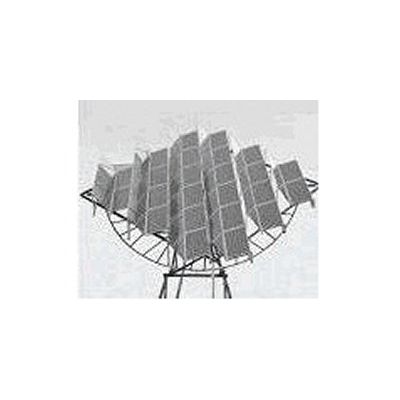
Very Low Concentration System (VLC)
The VLC (Very Low Concentration System) reduces the amount of photovoltaic modules needed for the same energy, and thus, producing a cost reduction if used with a low cost two-axis sun tracking system (TETRA-TRACK). The main advantage of the VLC system is that it uses commercial flat-plate PV module technology available in the market. The system is composed by one flat PV module and an associated flat mirror. The PV panel is not positioned normal to the sun direction, but rather slightly tilted.
The aperture decrease that tilting the PV module produces in the panel compared to the V-trough system is highly compensated by the increase of aperture due to reducing the mirror`s angle. This is a consequence of the fact that the cosine of an angular variation close to 90º (mirror) suffers a greater increase than the same angular variation for angles close to zero degrees (panel).
Besides, the radiation reflected in the mirror, strikes with a better angle over the PV panel surface, decreasing loses due to reflection in the glass surface.
The practical concentration index is lower than 2x (C<2).
Since the system is open and does not have a focus point, the PV modules receive a good amount of solar dispersed radiation. This diffuse solar radiation comes from the sides of the PV module as well as from the back.
This simple system increases the power output of the PV module. The net maximum power obtained is between 140% and 180% compared to the same PV module without concentration.
The receiver is composed by regular flat-plate high efficiency monocrystalline Si PV modules for making more profitable the inversion. The mirrors are made of glass (although other materials with better reflectance can be used) because its high resistance to scratching and weather agents. The back surface and the edges are protected to avoid humidity, which deteriorates the reflectance surface.
The most common flat PV panel concentration system is the V-trough. This system uses two lateral mirrors sited aside the panel. Concentration ratios greater than 2x can be obtained using this procedure. However, using this system and these concentration ratios, degradation of the PV panels may occur as a consequence of the extra radiation collected by the PV modules.
On the other hand, high temperature reduces the PV module efficiency as a consequence of the voltage drop and serial resistive losses. This losses increase proportional to the current square value provided by the PV panel. The VLC system reduces the thermal losses over the PV module because natural convection cooling is increased if compared to this systems.
Advantages of the VLC System compared to other PV Systems:
-
Reduction of cells` surface (the most expensive element of the system) between 33% and 50% for the same installed power than a fixed system (concentration factor between 1.5x and 2.0x).
-
Reduces PV energy costs if used with a low-cost two-axis sun tracking system (TETRA-TRACK)
-
Increases PV module and mirror hail resistance.
-
Reduces time for assembly and trimming the mirrors (compared to V-trough systems).
-
Reduces the PV module thermal load since it increases natural cooling with regards to any other static concentration system.
-
Quick change from concentration to direct exposure if over temperature is detected.
-
Takes advantages of a great amount of disperse solar radiation.
-
Decreases platform wind loads without loosing collecting surface. The useful collecting surface is equal to the occupied surface.
-
Uses conventional and available flat-plate PV technology.