
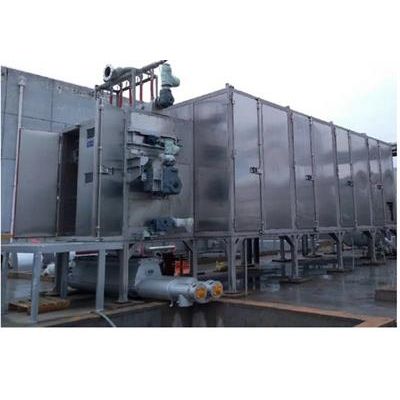
VOR - Model LTD Series -Belt Dryer
Sludge is dried to save sludge hauling and disposal costs, and to use as fertilizer as well as fuel—its caloric value is similar to that of lignite. A further reduction of the sludge weight is possible with help of sludge drying, by evaporating the remaining bound water in the dewatered sludge.
Belt Dryers LTD series are automatically and continuously operated and optimally suitable for energy-saving and eco-friendly drying of municipal and industrial sludge. The product is distributed on an endless, air permeable conveyer belt and is flooded with heated air. The drying air is circulated and saturated with each pass though the product layer. A specific part of the drying air is replenished with fresh air and at the same time corresponding vapours are removed. For optimum energy efficiency the drying air is directed against the product flow. Solids contents in the dried product of 60 to 90% DS can be achieved. The sludge can be simultaneously disinfected as the sludge is maintained at atemperature of minimum 70 ° for 40-60 minutes. No odor overflow, no need external heat resource and cooling water as well as other harsh conditions.
LTD can make use of waste heat, such as hot water, stream, natural gas, etc. We are the only one in China that can supply belt dryer with all kinds of heat source.
Drying Process
- Dewatered sludge or digested sludge continuous input to sludge bin;
- The plough distributes the sludge evenly on the sludge extruder;
- The sludge will be squeezed into narrow strips by the extruder
- The squeezed narrow strips will evenly fall on the drying belt, the continuous strips increased the surface area of the material that help for efficient heating;
- The belt moved at a speed of a few centimeters per minute, the low speed avoid the dust generation during the drying process;
- As the sludge passes through the continuous chambers, the gas temperature rises gradually, and heat the sludge to designed temperature for evaporation;
- The heat exchanger uses the cold liquid produced from the heat pump as a cold source to condense the gas, and uses the heat of the heat pump to heat the gas in the dewatered sludge
- The blower keeps the process gas circulating in the system to carry out the drying process and maintain the system in a negative pressure state;
- Heat pump can produce 9o0C heat liquid as sludge drying heat source, and provide cold liquid to condense the gas, total COP can reach 16 and more;
- The washing system periodically cleans the conveyor belt to ensure proper
- permeability;
- The LTD series configure the controller with PLC, which can be connected to
- Ethernet or other communication ports for all top communication Protocol.
- As the sludge maintained at a temperature of minimum 70°for about 50-7omins,
- the final dry solids are safely disinfected (class A) in compliance with European and
- USA standard. Electricity power per kilowatt-hour can evaporate 2.4 kg water.
- Flexible processing capacity, dryness can be selected from 65 % to over 90 %DS,
- High availability, continuous automized operation;
- Safety operation due to low dust generation (<smg/NM3);
- Low operation and maintenance costs;
- Low exhaustemission: deodorization with scrubber and bio-filter
- Low COD load: low drying temperature (i20-iso°C) makes the evaporation condensation water COD <20omg/L;
- Pasteurization : The sludge can be simultaneously disinfected as the sludge is maintained at a temperature of minimum 70 * for 40-60 minutes;
- arious supply of heat source : e.g,. from natural gas, thermal oil, steam, hot water, hot oil, emission gas, and cooling water;
- Safe to disposal or use the final product: e.g direct landfill, burning, fertilizer;
- Low energy consumption: the energy per kilowatt can be converted to 4I0V heat;
- Low investment: compact and modular structure, simple design;
- Easy operation: the system can reach full load operation in ismins, and can be shut down in 20 mins.