


- Home
- Companies
- CorPower Ocean AB - part of Inovacor AB
- Products
- CorPower Ocean - Wave Energy Converter
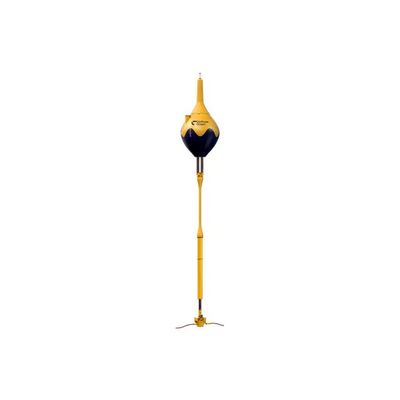
CorPower Ocean - Wave Energy Converter
Inspired by the pumping principle of the human heart, our technology is informed by 40 years of hydrodynamic research, allowing for a lightweight and low-cost design that maximizes generation capacity and provides robust operation in the harshest ocean conditions.
The human heart uses stored hydraulic pressure to provide force for the return stroke, thereby only requiring the muscles of the heart to pump in one direction.
In a similar way, our Wave Energy Converters use a pre-tension system to pull the buoy downwards. Wave swells push the buoy upwards, while the stored pressure provides return force to drive the buoy downwards. This results in an equal energy production in both directions and a lightweight system that is naturally transparent to ocean waves (detuned) unless actively controlled.
The wave farm concept is based on combining hundreds to thousands of units in arrays, with a common grid export cable that connects the offshore wave farm to existing on-land grid. With a WEC rating of 250kW per unit in a typical Atlantic coast climate this enables 10-250MW wave farms with 40-1000 units. The concept allows mass production to drive down cost per unit and a maintenance scheme based on replacement of entire units at sea. This avoids performing service activities in the harsh offshore environment and offers improvements in farm up-time and reduction of O&M cost.
Our Wave Energy Converters are point absorber type, with a heaving buoy on the surface absorbing energy from ocean waves. The buoy is connected to the seabed using a tensioned mooring system.
Energy stored in waves are converted into electricity through the rise and fall as well as the back-and-forth motion of waves. The composite buoy, interacting with this wave motion, drives a Power Take Off inside the buoy that converts the mechanical energy into electricity.
- Lightweight system with high natural frequency of oscillation.
- Inherently resonant by WaveSpring control.
- Detuned in storms, strongly reducing the loads providing good survivability up to 32m waves.
- 5 times higher Annual Energy / mass compared to conventional point absorbers without phase control. [MWh/ton]
- 3 times higher Annual Energy / PTO Force compared to conventional point absorbers without phase control. [MWh / kN]
- Low CAPEX per kW, and effective service and maintenance using a replacement scheme
- Wavespring technology : WaveSpring technology amplifies the motion and power capture. This negative spring function provides 3x increase in energy production for a given buoy size, strongly increasing revenue to cost.
- Cascade gearbox : The buoy motion is converted into electricity by a mechanical drive train inside the buoy. A Cascade gearbox converts linear motion into rotation with high efficiency and long lifetime. The design principle resembles that of a planetary gearbox, distributing the load over multiple small gears.
- Pre-tension cylinder : The pre-tension system provides downward force on the buoy using a pneumatic cylinder. This replaces mass that would otherwise be needed to balance the buoyancy at midpoint, reducing cost and carbon footprint. It also makes the device naturally protected from storm waves.
- Composite buoy : The buoy hull is a spherical composite structure designed for high volume low-cost production. A novel mobile factory concept is used to fabricate the hulls locally on customer sites.
- UMACK anchor : UMACK anchors outperform gravity anchors and conventional monopiles in terms of holding capacity, cost and carbon footprint. It is installed with a high-speed and low noise vibro-driving method, making it friendly to marine life.
- Advanced control : The real-time control system runs on state-of-the-art model-based optimal control algorithms that maximises the power output while ensuring safe operation in all condition.
- CorPack rating : 10-30 MW
- Operational range (Hs) : 0.25-8m
- Buoy diameter : 9m
- Spatial density : 15MW/km2
- Installation depth : >40m
- Height : 18m
- Capacity factor : 40-60%
- Device rating : 300kW
- Weight : 70tonnes