
EWP - Wave Energy Technology for Clean Electricity Generation
Eco Wave Power (Nasdaq US Stock Symbol: WAVE) developed an innovative technology for production of clean electricity from ocean and sea waves. We aim to generate clean & affordable electricity, using a simple but smart design, allowing our floaters to be attached to existing man-made structures, and thereby simplifying installation and maintenance as well as accessibility. EWP’s innovative technology has been recognized as a “Pioneering Technology” by the Chief Scientist of the Energy Ministry of Israel and received an Efficient Solution label from Solar Impulse Foundation. In addition, the company won the United Nations “Global Climate Action” Award and received grants by ERDF, Horizon 2020 and the Energy Ministry of Israel. The company is pioneering in its’ sector by operating a grid-connected wave energy array, which is operational under a PPA (Power Purchase Agreement) and holds substantial number of projects in its’ pipeline.
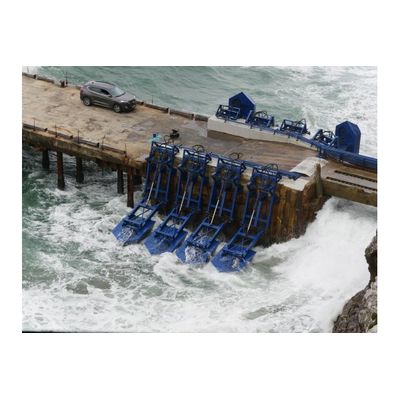
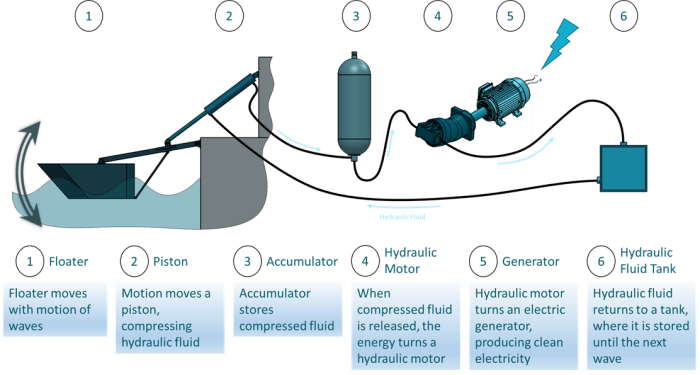
The floaters draw energy from incoming waves by converting the rising and falling motion of the waves into an clean energy generation process. More precisely, the movement of the floaters compresses and decompresses hydraulic pistons which transmit bio-degradable hydraulic fluid into land located accumulators. In the accumulators, at a pressure is being built. This pressure rotates a hydraulic motor, which rotates the generator, and then the electricity is transferred into the grid, via an inverter.
The fluid, after decompression, flows back into the hydraulic fluid tank, where it is then re-used by the pistons, thus creating a closed circular system.
The system commences production of electricity from wave heights of 0.5 meters.
The whole operation of the system is controlled and monitored by a smart automation system. Also, when the waves are too high for the system to handle the floaters automatically rise above the water level and stay in the upward position until the storm passes. Once the storm passes, the floaters return to operation mode.
In search of the high energy potential available in offshore waves, several wave energy developers have located their systems offshore. However, these systems struggled to commercialize due to:
-
High costs: The CAPEXs associated with offshore systems are high, as there are high costs implicit in the installation, maintenance, and connection to the electrical grid of such systems. Since their offshore deployment requires the use of ships, divers, underwater electrical transmission cables, and underwater mooring.
-
Low Reliability: Off-shore ocean climates are often extremely harsh and can experience wave heights as high as twenty meters. Stationary man-made machinery struggles to survive in these types of conditions for extended periods of time.
-
Lack of insurability surrounding off-shore systems: The high-costs and low reliability associated with offshore wave energy systems, created an issue with getting insurance for the offshore wave energy power stations.
-
Negative environmental impact of offshore systems: Environmental organizations have considerable say in the deployment of new technologies. However, many have objected to the deployment of offshore wave energy systems as many of them require mooring to the ocean floor, which disturbs local marine habitats and to potentially impeded marine migration.
Resulting from the difficulties experienced by the offshore competitors in the wave energy sector, Eco Wave Power decided to take a different approach by installing its’ systems in the onshore and nearshore environment & attaching it to marine structures, such as breakwaters.
A new study in the wave energy sector supports Eco Wave Power’s approach. For example, in Figure 1, we can see that although the maximum wave power is higher offshore, the exploitable level of power in the offshore and nearshore is practically the same, due to the following:
In deep water, waves can travel in almost any direction, making it difficult to extract energy. As they approach the shore, they turn towards it, so WECs positioned in near-shore locations almost always encounter waves coming from the same direction. This significantly boosts the quantity of energy captured. Furthermore, wave profiles are usually milder closer to shore: maximum wave heights in near-shore areas are closer to average wave heights – implying that WECs in near-shore areas tend to encounter more stable sea states – providing highly exploitable wave energy resources compared to off-shore locations.
A study[1] by the Indian Institute of Technology is also supporting the claim that the best location for energy generation is indeed breakwaters.
A support of such advantages of onshore wave energy can be seen in a recent study by the Institute of Marine Sciences and Technology at Dokuz Eylül University which determines that onshore technologies have significantly higher survivability and is more cost effective than offshore solutions.[2]
Moreover, Eco Wave Power appeared in a recent study by Dr. Peter Harrop which finds that interest in waterpower is on the rise again as large orders are landed.[3] The new vibrancy primarily concerns avoiding huge infrastructure and putting simpler devices particularly in the sea. At last, marketing led approaches satisfy new needs, particularly in a vast number of cases where cost of electricity is not key. He also mentioned Eco Wave Power in his detailed study as one of the most dominant technology and provides deep technology analysis. In his study, he is forecasting that the market will rise to at least USD 100 billion.
The development of the Eco Wave Power technology began at the Institute of Hydromechanics in Kiev in 2011, with wave tank testing. In December 2011, Eco Wave Power concluded its wave tank testing and received a protocol from the Hydro Mechanic Institute, which stated as follows:
“All the floaters of Eco Wave Power Company have proved their workability… According to the results of the tests, we have reached a decision to recommend continuing the development of the energy generation system that is based on such principles and enlarge the model to larger sizes.”
In April 2012, Eco Wave Power installed the company’s first real conditions power plant on two breakwaters in the Black Sea for the purpose of data collection and stress testing of its unique technology. The Black Sea was chosen to conduct the system’s initial real-condition installation, because it is known for its sudden storms (this is how it got its name), and it was important for EWP to test its technology in severely stormy conditions to prove that its power stations could withstand such storms.
The power plant had combined two different floater shapes; the Wave Clapper and the Power Wing. The system operated in different wave regimes for a significant period of time, and then was shipped to Israel and installed in Jaffa Port, where it is operational until today.
The company nowadays operates several projects and has an extensive projects pipe line, to be gradually executed. Please find further information in the Projects Tab of our site.
Eco Wave Power’s proprietary technology is a unique and innovative approach to the wave energy system design, which provides the following competitive advantages:
Cost-Efficient
The EWP technology has attractive construction and production prices. EWP’s cost is significantly lower than offshore competition, since during Eco Wave Power’s installation and O&M activities, the company does not require the use of ships, divers, underwater cabling and mooring.
Reliable
Eco Wave Power’s technology is highly reliable as most of the cost of the system located on land, and only the floater mechanisms are located in the water. Therefore, the Eco Wave Power conversion unit is not subject to an aggressive marine environment. Furthermore, the Company utilizes storm protection mechanism, which prevents damages to the floaters during storms.
Full insurability
The reduced CAPEX and high reliability associated with the Eco Wave Power system allowed EWP to receive insurance for its power stations. the Company’s installations in Gibraltar and Israel are insured by notable insurance companies.
Environmentally friendly
The Eco Wave Power system does not connect to the ocean/sea floor and does not create a new presence in the surrounding marine environment.
Eco Wave Power recognizes the importance of the creation and protection of our IP, and therefore we use top experts in the field and invest significant resources in the maintenance of our global intellectual property portfolio. Eco Wave Power holds 17 patents and patents pending, including patents in the United States and Europe, as well as an International PCT on its proprietary technology.
-
System Design
-
Unique mechanism for float’s rise and submersion
-
Control systems
-
Innovative system for float’s mobility
-
Mechanism for protecting the system from shock waves
-
Lever Regulation Mechanism
-
Float Regulation Mechanism
-
Power Conversion
-
Wave Farm Architecture