


Aiguasol TRNSYS - Version 18 -Energy System Simulation
Extremely flexible graphically based software environment used to simulate the behavior of energy systems and energy building simulation (including LEED energy modelling).
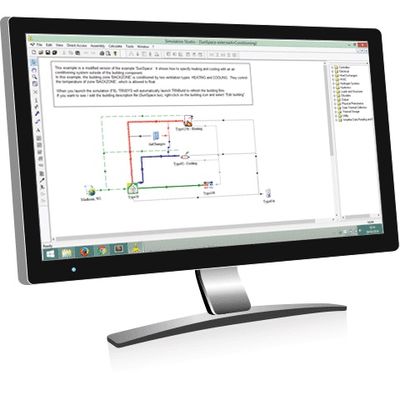
TRNSYS is an extremely flexible, graphically based software environment used to simulate the behavior of transient systems. The vast majority of simulations are focused on assessing the performance of thermal and electrical energy systems.
Because of the wide user base, the tool’s long history and its inherent flexibility, it is actively being used in many of the following applications:
- Energy in buildings
- Energy Building Simulation
- SOLAR THERMAL PROCESSES
- Solar Thermal Processes
- GROUND-COUPLED HEAT TRANSFER
- Ground-Coupled Heat Transfer
- solar-thermal-energy
- High-Temperature Solar Applications
- geothermal energy
- Geothermal Heat Pump Systems
- airflow simulation
- Coupled Airflow Modeling
- ENERGY SYSTEM RESEARCH
- Energy System Research
- Technology Assessment
- CHP combined heat and power plants
- Power Plants
- Hydrogen Fuel Cells
- Hydrogen Fuel Cell
- wind energy
- Wind and Pv Systems
- energy systems calibration
- System Calibration
TRNSYS is mainly used by engineers, architects and energy consultants to design and optimize energy systems (focus on renewables and emerging efficient systems) and to design low-energy buildings.
TRNSYS is made up of two parts. The first is an engine (called the kernel) that reads and processes the input file, iteratively solves the system, determines convergence and plots system variables. The kernel also provides utilities that, among other things, determine thermophysical properties, invert matrices, perform linear regressions and interpolate external data files.
The second part of TRNSYS is an extensive library of components, each of which models the performance of one part of the system. The standard library includes approximately 150 models ranging from pumps to multi-zone buildings, wind turbines to electrolyzers, weather data processors to economics routines, and basic HVAC equipment to cutting edge emerging technologies. Models are constructed in such a way that users can modify existing components or write their own, extending the capabilities of the environment.
After 35 years of commercial availability, TRNSYS continues to be a flexible, component-based software package that accommodates the ever-changing needs of researchers and practitioners in the energy simulation community.
Comprehensive libraries
TRNSYS includes Standard Libraries with many of the components commonly found in building energy systems as well as routines to handle weather data, solar radiation processing, basic HVAC equipment, hydrogen fuel cells, solar thermal and electric technologies, thermal storage, coupling to other simulation tools and simulation results processing.
Although TRNSYS includes the Standard Library for most common energy systems, it includes a method for adding new modules, allowing users to easily modify or create new components for technologies that are not covered.
In addition to the Standard Library included in TRNSYS, users can purchase TESS libraries including more than 250 components. Each of the component libraries comes with a TRNSYS Model File (*.tmf) to use in the Simulation Studio interface, source code and an example TRNSYS Project (*.tpf) that demonstrates typical uses of the component models found in that library.
TESS Libraries represent the best of in-house types at TESS (Thermal Energy System Specialists).