

TRAXX
  1. Companies
  2. TRAXX
  3. Software
  4. TRAXX - Tightening Management Software ...

TRAXXTightening Management Software (TMS) for Turbines and Flanges

FromTRAXX
SHARE
The Tightening Management Software (TMS) developed by TRAXX is designed to streamline the process of bolt tightening in turbine assemblies, offering versatile application across various industry sectors. It facilitates precise control over the tightening of components such as blades, seals, and mechanical parts to maintain optimal turbine operation and reliability. The software guarantees flawless alignment and uniform airflow, maximizing thermal to mechanical energy conversion. TMS also supports data export and integration with existing databases for comprehensive tracking and monitoring. It is configurable for different turbine sizes, screw compositions, and tightening sequences. The adaptability ensures optimal clamping tailored to specific industrial requirements. Notably, TMS is utilized in assembling General Electric's 7HA and 9HA turbine models, in the automotive sector for engine component assembly, and in constructing large-scale infrastructure like bridges. By enhancing maintenance efficiency, it contributes to reduced operational costs.
Most popular related searches

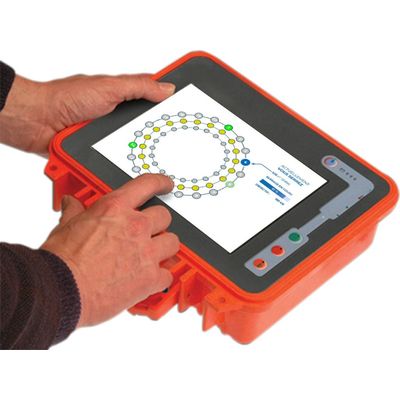
A long-term turbine tightening software that enables ongoing monitoring and regular tracking of assemblies.

Displays the tightening limits for each screw.

Bolt tightening software enables the export and processing of tightening data on your business database.”

Why use bolt tightening software ?

Ensuring a precise tension tightening of components in a gas turbine is imperative to guarantee its optimal operation and long-term reliability. Each element, be it blades, seals, or mechanical parts, must be securely fastened to avoid potential issues such as gas leaks, excessive vibrations, or structural failures. The bolt tightening software also ensures flawless alignment of elements, promoting a uniform flow of air and gas through the turbine, thereby maximizing the conversion of thermal energy into mechanical energy. Moreover, precise control of tightening facilitates maintenance operations and regular inspections, thereby contributing to cost reduction and minimizing downtime. The TMS software offers a comprehensive solution to achieve these crucial objectives, enabling optimal control of the tightening of gas turbine components.

The bolt tightening software : a versatile and adaptable system

The bolt tightening software stands out as a highly versatile and adaptable system, offering a comprehensive solution for precision clamping. Its configurability spans various parameters, including turbine size, the composition of screws, tightening sequences, the number of tightening passes, the involvement of operators, programmed tension or elongation limits, and diverse measurement units. This software ensures a flexible and tailored approach to bolt tightening across a range of applications, providing optimal control and precision in the clamping process.

The bolt tightening software through 3 examples

The bolt tightening software finds application across various scenarios. One notable example is its utilization by engineers at General Electric during the assembly of turbines 7HA and 9HA. In this context, the software ensures precise and configurable clamping tailored to the specific requirements of these turbine models.

Another application arises in the automotive industry, where the software is employed in the assembly of critical engine components, such as cylinder heads and connecting rods. The adaptability of the system allows for customized tightening sequences and ensures the desired tension levels in each fastener, contributing to the overall reliability and performance of the engines.

Additionally, the bolt tightening software is extensively utilized in the construction of large-scale infrastructure projects, such as bridges and towers. The configurability based on factors like the size of structural elements and specified tension limits enables engineers to achieve optimal clamping in various construction scenarios, enhancing the structural integrity and longevity of the completed projects.