


- Home
- Companies
- Jiangsu Grand-Hope New Materials ...
- Applications
- Carbon Felt Fiber Optics for ...
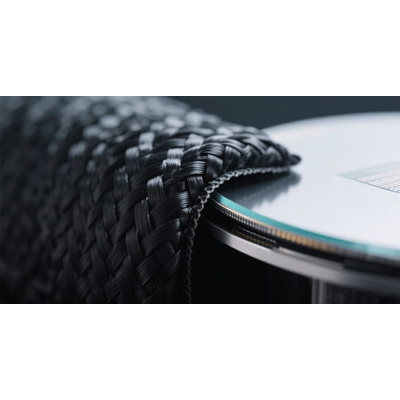
Carbon Felt Fiber Optics for Semiconductor Silicon Wafer Industry - Electronics and Computers - Semiconductors
High-performance carbon fiber insulation materials in the semiconductor silicon wafer industry. In the semiconductor silicon wafer industry, even the slightest defects, contamination, or stress can lead to a significant drop in chip yield. Therefore, the requirements for the purity, stability, and precise controllability of the production environment, especially the thermal field, have reached an extremely high level.
Single Crystal Furnace Hot Zone System
The hot zone is the heart of the single crystal furnace, comprising all high-temperature components such as heaters, crucibles, insulation barrels, flow guides, and electrodes. Its function is to provide heat, maintain temperature, and precisely control temperature gradients. High-performance carbon fiber composite insulation materials have found an indispensable role here.
The value of high-performance carbon fiber insulation materials:
Shaping an ideal temperature gradient: Capable of forming and maintaining a steep and stable axial temperature gradient, which is crucial for ensuring a flat crystal interface, suppressing dislocation defect proliferation, and improving single crystal quality.
Ultimate energy efficiency: Exceptional radial insulation performance directly translates into significant reductions in electricity costs.
Enhanced process stability: The material itself is stable, does not powderize or settle, ensuring consistent thermal field performance after hundreds of thermal cycles and improving process repeatability and yield between furnaces.
2. Thermal field auxiliary components (flow guides, heat shields)
Above the crucible and around the growing crystal rod, certain components are required to fine-tune the thermal field and protect the crystal.
Value provided by high-performance carbon fiber insulation materials:
Control oxygen content: Silicon melt can dissolve oxygen from the quartz crucible, and oxygen concentration is a critical parameter affecting device performance. By adjusting thermal field auxiliary components, melt convection can be precisely controlled, thereby stabilizing oxygen content within the target range.
Reduce crystal defects: A gradual crystal cooling process effectively reduces the formation of lattice dislocations and slip lines.
Improved yield rate: A stable thermal field environment is a prerequisite for growing large-diameter, defect-free single-crystal silicon ingots.
3. Structural Connections and Support Components
Various components are required within the thermal field to support heavy crucibles and secure heaters.
Value provided by high-performance carbon fiber insulation materials:
Extremely high reliability: Excellent resistance to mechanical impact and thermal shock, with a long service life.
Thermal compatibility: Its coefficient of thermal expansion (CTE) can be matched with surrounding graphite components during design, preventing stress caused by thermal expansion and contraction mismatches.
Reduced thermal interference: Low thermal conductivity minimizes unnecessary heat loss and local cold spots.
In the semiconductor silicon wafer industry, the application of high-performance carbon fiber composite insulation materials is not merely a material replacement but a revolutionary upgrade of the core technology of single crystal growth—“thermal field management.” It directly enables the production of larger-sized (450mm), lower defect density, and higher resistivity uniformity silicon wafers, thereby meeting the stringent requirements of advanced process chips (such as 3nm and 2nm) for substrate materials. It is one of the key foundational materials driving the continued advancement of Moore`s Law.