


- Home
- Companies
- HRS Heat Exchangers Ltd.
- Articles
- Not all gas coolers are equal
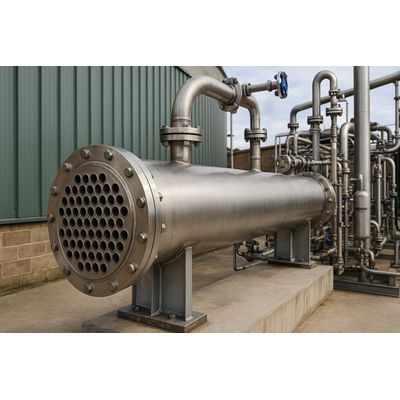
Not all gas coolers are equal
Gas cooler designs for exhaust-gas heat recovery and biogas dehumidification vary, but many service highly corrosive gas mixtures. Material selection and system design determine whether equipment will meet expected longevity and performance in these conditions.
Exhaust gas heat recovery is now common across industries, delivering cost savings and environmental benefits. With as much as 35% of an engine’s fuel wasted as exhaust heat, substantial value can be realized from heat exchangers in exhausts or flues, enabling quicker recoupment of initial capital expenditure.
Similarly, as anaerobic digestion and landfill gas use expand, awareness grows of water-associated issues such as corrosion and cavitation in CHP engines and generators. This has driven demand for biogas dehumidification solutions.
Raw biogas and exhaust gas comprise a range of compounds, from relatively inert carbon dioxide and nitrogen to oxides of nitrogen and sulfur, siloxanes (which can form highly corrosive or abrasive phases), and organic compounds, particulates and heavy metals that increase fouling potential.
Without systems specifically designed for such aggressive environments, heat exchangers risk fouling, corrosion, or failure. At best this reduces operating efficiency; at worst, it can necessitate premature replacement.
Compared with carbon-steel construction, HRS’s K Series and G Series Gas Cooling Heat Exchangers use AISI 304 and AISI 316L stainless steel and employ corrugated-tube technology to boost heat transfer and mitigate fouling. In practice, this configuration can yield multi-year life advantages in aggressive service relative to lower-cost carbon steel units.
This durability helps explain deployments by customers such as LMS Energy and Melbourne Water, which have installed stainless-steel HRS K Series corrugated shell-and-tube heat exchangers and Biogas Dehumidification System, respectively.
HRS offers systems spanning digester heating, pasteurisation, digestate concentration, biogas dehumidification, and sludge and exhaust-gas heat recovery. Installed at more than 200 biogas plants worldwide, these solutions aim to improve plant efficiency and overall operation.
Original: https://www.hrs-heatexchangers.com/news/not-all-gas-coolers-are-equal/?utm_source=rss&utm_medium=rss&utm_campaign=not-all-gas-coolers-are-equal