

- Home
- Companies
- OTT HydroMet Solar Energy
- Articles
- Soiling, Performance Risk, and Capacity ...
Soiling, Performance Risk, and Capacity Testing in Utility-Scale Solar
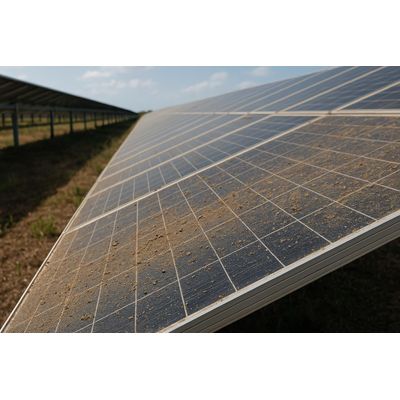
Soiling—accumulation of dust, dirt, pollen, agricultural residue, and other airborne particulates on PV module surfaces—causes light transmission losses and measurable power reductions. While its impact on ongoing operation is well established, soiling also affects capacity and performance testing, where even small losses can carry contractual and financial implications. Field studies indicate soiling losses of approximately 1–2% can influence capacity outcomes in utility-scale plants, and these losses are frequently measured too late to inform commissioning decisions.
What Is Soiling in Solar PV Systems?
Soiling refers to the accumulation of dust, dirt, pollen, agricultural residue, and other airborne particles on PV module surfaces. These particles reduce light transmission through the glass, resulting in measurable power losses. The magnitude of soiling losses varies with local climate and precipitation, land use and nearby activities such as farming or construction, wind direction and seasonality, and cleaning frequency and site accessibility. While soiling is commonly addressed during operation, its effect during commissioning and capacity testing is often underestimated.
Why Soiling Measurement for Capacity Testing Requires a Different Strategy
Utility-scale PV projects must demonstrate performance compliance before milestones such as substantial completion. Capacity tests validate system output and are typically conducted under standards such as ASTM E2848 or evolving international methods. These tests allow only limited total losses. Even modest unexplained losses can cause a test to fail. Field data show that soiling losses of 1–2% can, when combined with normal measurement uncertainty, push a technically sound system outside acceptable performance limits, leading to delays, disputes among developers, EPCs, and asset owners, unplanned cleaning or retesting costs, and increased uncertainty for financiers. When capacity tests fail due to unexplained losses, consequences extend to contractual allocations of responsibility for cleaning, loss compensation, and test acceptance criteria. In many projects, the treatment of soiling during capacity testing is not fully defined in contracts before construction, leading to last-minute negotiations, unplanned cleaning, or repeat testing campaigns and thus higher costs and schedule risk. By contrast, projects that incorporate defensible soiling measurement strategies early in construction are better positioned to manage these risks transparently and efficiently. Accurate soiling data does not eliminate commercial discussions, but it provides a shared, objective basis for them.
The Hidden Risk: Soiling Is Often Measured Too Late
Most utility-scale solar plants include soiling sensors as part of a meteorological station, designed primarily for long-term operational monitoring rather than commissioning. Consequently, sensors are often installed after PV modules have already been exposed to environmental conditions for weeks or months. This creates a mismatch: modules accumulate soiling while sensors start from a clean state, and the sensors do not share the same exposure history, making their data unreliable for quantifying soiling losses during capacity testing.
Common Workarounds and Their Limitations
When representative soiling data is unavailable, project teams commonly rely on visual inspection or photographs, pre- and post-cleaning electrical measurements, or negotiated assumptions about acceptable losses. These approaches introduce subjectivity, cost, and delay, but many challenges can be avoided through earlier measurement planning.
Measure Soiling from Day One: A Proactive Strategy
Field research consistently recommends deploying soiling sensors concurrently with PV module installation. This ensures identical environmental exposure during construction and commissioning, enabling reliable compensation of soiling losses during capacity testing, early identification of excessive soiling, data-driven cleaning decisions, and reduced contractual ambiguity. Importantly, this approach does not require early SCADA integration: sensors can be installed and left unpowered during construction since calibration is not required and they accumulate soiling naturally. When commissioning approaches, sensors can be activated and immediately provide representative soiling loss data without months of prior logging, removing a major practical obstacle to early soiling measurement and enabling more reliable compensation during testing.
- Sensors can be installed concurrently with module deployment and left unpowered during construction; calibration is not required, as they accumulate soiling passively.
- SCADA integration is not a prerequisite for early soiling data; representative capacity-testing data can be produced at commissioning without months of logging.
What Makes a Soiling Sensor Suitable for Capacity Testing?
Research identifies four requirements for sensors used during construction and commissioning:
- Calibration-free operation—Allows immediate installation without delaying project schedules.
- High sensitivity at low loss levels—Capacity testing requires resolution below 1%, with sensitivity to changes under 0.5%.
- Ease of deployment—Sensors must be compact, robust, and suitable for construction environments.
- Cost-effective scalability—Soiling varies across large sites; distributed measurement improves confidence.
These principles align with Kipp & Zonen’s long-standing focus on measurement accuracy, robustness, and traceability. With Atonometrics now part of the Kipp & Zonen portfolio, optical soiling measurement is integrated into a broader, bankable solar measurement framework.
Field Evidence: Soiling Is Spatially Variable
Field data from a ~100 MW utility-scale PV plant show that soiling is rarely uniform across a site. Measurements indicate rapid accumulation during nearby agricultural activity; losses reach several percent within weeks; spatial variation depends on location and wind exposure. These results demonstrate that assuming uniform soiling across a utility-scale site can materially misrepresent actual performance during capacity testing, reinforcing the need for distributed soiling measurement rather than relying on a single sensor.
Linking Soiling Data to Capacity Test Outcomes
Across multiple capacity testing campaigns, field measurements show a clear relationship between reductions in soiling losses (from rainfall or cleaning) and improvements in measured capacity test ratios. This demonstrates the value of soiling data in distinguishing environmental effects from system-related issues during performance validation.
Understanding the Limits of Soiling Measurement
While optical soiling sensors measure transmission losses, they do not capture all electrical loss mechanisms. Non-uniform soiling patterns can lead to additional power losses that require complementary diagnostics. Soiling measurement should therefore be part of a comprehensive performance assessment strategy, not a standalone metric.
From Reactive Testing to Proactive Performance Assurance
Soiling has traditionally been treated as an operational issue. Research now shows it should also be considered a commissioning and project-delivery risk. Early soiling measurement strategies complement broader solar resource and irradiance measurement practices, helping ensure consistency between commissioning data, long-term performance monitoring, and bankability assessments across the project lifecycle. At Kipp & Zonen, accurate measurement enables confident, defensible decisions across the full lifecycle of a solar asset. Contact us to learn how early, accurate soiling measurement can reduce performance risk and support confident capacity testing in your utility-scale solar projects.
Original: https://blog.otthydromet.com/en/soiling-performance-risk-and-capacity-testing-in-utility-scale-solar/