
- Home
- Companies
- ETA-Florence Renewable Energies
- Events
- 23rd European Biomass Conference and ...
23rd European Biomass Conference and Exhibition 2015
The European Biomass Conference and Exhibition (EU BC&E) ranks as one of the top world leading events in the Biomass sector, combining a highly respected international Conference with an Industrial Exhibition. It highlights progress in research, technological development and production processes. It brings together all key specialists to make it the most important international platform for dialogue between research, industry, research and industry, and policy in the biomass sector.
The EU BC&E provides:
- A high-level Scientific Programme
- Parallel events
and it attracts:
- Participants from a wide-ranging background: researchers, engineers, technologists, standards organisations, policy and decision makers, financing institutions
- Research & industrial exhibitors

The EU BC&E covers the entire value chain of biomass to conduct business, to network, and to present and discuss the latest developments and innovations.
The EU BC&E is supported by European and international organizations such as the European Commission, UNESCO - United Nations Educational, Scientific and Cultural Organization, Natural Sciences Sector, EUBIA - the European Biomass Industry Association, WCRE - the World Council for Renewable Energy and further organisations.
The Technical Programme is coordinated by the European Commission, Joint Research Centre.
The European Biomass Conference and Exhibition is the leading annual international biomass event in Europe. It brings together the stakeholders of the industry and will thus provide you with the unparalleled opportunity to present your company in this exclusive environment.
Being a Sponsor of the EUBCE 2015 means positioning your business in the environment of a renowned international event dedicated to biomass industry, policy and research.
Extend your research to key industry representatives, researchers, policy makers and other experts within the biomass community.
The EUBCE offers modular and flexible sponsorship packages.
Advantages
- obtain maximum visibility at the 2015 Biomass Event and attract the attention of the community of renewable energy;
- connect your company to one of the most recognised and successful international events with an excellent scientific content;
- broadcast your message to operators, scientific and industrial stakeholders of the biomass industry;
- obtain communication results in a direct and efficient way;
- choose between different sponsorship opportunities;
- benefit from communication services of the event.
The EUBCE is the event in which the members of the bioenergy community can get a broad picture of the situation and trends emerging in today`s market.
The Conference provides a high-level scientific programme and parallel events which attract participants from a wide-ranging background: researchers, engineers, technologists, standards organisations, financial institutions, policy makers and decision makers.
This event is supported by European and international organizations. The Technical Programme is coordinated by DG Joint Research Centre of the European Commission.
New Topic 5: Bioenergy in Integrated Energy Systems
Deployment of renewables at a very large scale requires impact-advanced strategies and technologies for energy system integration. Development and demonstration of such solutions should be done in the broad context of the transition to a sustainable energy system, where Bioenergy is accompanied by other renewables and a changing range of conventional energy technologies.
This Focus Session aims to bring together energy system specialists, experts from the renewable energy sectors and other stakeholders to present and discuss experiences, plans and options for advanced system integration.
Present at the EUBCE Conference - An opportunity for the bioenergy industry
Based on the success and positive feedback regarding the initiative in the past edition of the conference, the EUBCE Executive Committee has decided to set-up a specific Industry dedicated section in the Programme in order to promote the interest and needs of the bioenergy sector and establish a platform to influence the market deployment of new innovative bioenergy technologies while at the same time addressing key policy initiatives.
The aim is to create a balance in the event between the scientific content and the industry contributions to ensure the coverage of the entire bioenergy value chain.
All industry experts and players are invited to contribute and to submit abstracts, propose workshops or events, suggest industry speakers and make constructive recommendations to serve the needs of the bioenergy industry.
This is an opportunity for the bioenergy industry to reinforce the 23rd EUBCE Conference programme!
SUBJECT 1: BIOMASS RESOURCES
1.1 Biomass potentials and biomass mobilisation
Assessments of biomass potentials and land availability at regional, national and international levels; Biomass mobilisation; Biomass logistics; Spatial modelling and remote sensing; Resources mapping.
1.2 Biomass feedstock, residues and by-products
Supply of residues and by-products from agriculture and forestry: mobilisation, characterisation, harvest technologies, logistics and storage.
1.3 Energy crops and energy grasses
Agricultural production of non-woody plant biomass: plant breeding, cultivation, characterisation and harvest technologies, logistics and storage; Novel crops and alternative cropping systems.
1.4 Short rotation forestry and short rotation coppice
Agricultural production of woody biomass: plant breeding, cultivation, characterisation, harvest technologies, logistics and storage.
1.5 Algae production systems
Identification, assessment and optimisation of algae strains; Technologies and systems for algae cultivation, nutrition and harvesting; Oil and chemical extraction.
1.6 Municipal and industrial wastes
Potential of Municipal Solid Waste (MSW) for bioenergy, biofuels and bioproducts; Availability of biowaste from MSW; Techniques for source separation; Industrial wastes; Sewage sludge, slaughterhouse waste; Integrated waste management systems.
SUBJECT 2: BIOMASS CONVERSION TECHNOLOGIES FOR HEATING, COOLING AND ELECTRICITY
2.1 Production and supply of solid biofuels
Technologies for solid biofuel production: chipping, pelletising, briquetting, etc.; Production and characterisation of solid biofuels from innovative feedstocks; Solid biofuel logistics and storage.
2.2 Biomass and bioliquids combustion for small and medium scale applications
Innovative concepts for stoves, boilers, micro-CHP, steam and stirling engines, organic rankine cycles, etc; Abatement of corrosion and fouling; Emission control; Auxiliary equipment; Tri-generation (power, heat and cooling).
2.3 Biomass combustion in large utilities
Co-firing plants; Process monitoring; Control systems; Abatement of corrosion and fouling; Emission control; Tri-generation (power, heat and cooling).
2.4 Gasification for power, CHP and polygeneration
Fundamental studies; Technology development; Gas cleaning and upgrading; Gas utilisation and engine innovations; By-product utilisation.
2.5 Gasification for synthesis gas production
Fundamental studies; Technology development; Gas cleaning and upgrading; By-product utilisation.
2.6 Anaerobic digestion for biogas production
Characterisation and optimisation of anaerobic digestion; Plant and fermenter concepts; Anaerobic fermentation of innovative feedstocks; Biogas utilisation for power, CHP and poly-generation.
SUBJECT 3: BIOMASS CONVERSION TECHNOLOGIES FOR LIQUID AND GASEOUS FUELS, CHEMICALS AND MATERIALS
3.1 Production of advanced solid biofuels
Thermal upgrading of solid biofuels: Torrefaction, hydrothermal carbonisation, charcoal production, etc.
3.2 Pyrolysis and other biomass liquefaction technologies
Production of liquid bioenergy carriers from solid biomass: Fundamentals and studies; Technology development; Process characterisation and modelling; Hydrothermal liquefaction, bio-crude-oil upgrading and utilisation (combustion tests, chemical extraction, gasification, etc.); By-product utilisation.
3.3 Oil-based biofuels
Innovative processes for the production of oil-based fuels (biodiesel, aviation fuel, etc.) from oilseeds, algae, wastes, etc; Biofuel blending, distribution and logistics.
3.4 Biomethane
Upgrading of methane rich gases (biologically and thermochemically produced) and biomethane grid injection.
3.5 Bioethanol and sugar from lignocellulosic biomass
Lignocellulosic ethanol: Pre-treatment of lignocellulosic biomass, cellulose hydrolysis, C6 and C5 fermentation; Innovations in bioethanol production from starch and sugar plants.
3.6 Synthetic biofuels
Production of fuels from syngas; Innovative direct conversion process, etc. (FT-diesel, jet fuels, etc.).
3.7 Biorefineries and chemicals production
Biomass pre-treatment; Integrated multi-product approaches; Combined production of fuels, chemicals and materials from biomass; Sugar fermentation to other chemicals than ethanol; Drop in fuels, bio-plastics, hydrogen, etc.; Production of bio-fertilizers.
SUBJECT 4: BIOMASS POLICIES, MARKETS AND SUSTAINABILITY
4.1 Markets, Investments & Financing
Global bioenergy markets; Bioenergy commodities trading, contracting and long distance transport; Externalities assessment; Economic viability of bioenergy projects; Financial support schemes; Market stimulation policies; Partnerships programmes for supply security.
4.2 Sustainability assessment and criteria
Sustainability schemes, certification, national and international standards related to sustainability; Labelling for bioenergy and bio-products; Support programmes; Scientific monitoring; Sustainable resource management.
4.3 Environmental impacts of bioenergy
Life cycle analyses; Indirect land use change (ILUC); Agricultural intensification; Assessment of GHG reduction and carbon capture; Biochar for soil improvement; Estimated contribution to the mitigation of climate change; Agro-environmental assessments in temperate and tropical regions.
4.4 Resource efficient bioeconomy
Biomass use by utilities; Innovation, growth, job creation; Socio-economic opportunities, competition and risk mitigation of the increased use of biomass for food, feed, fibre, fuel, health, bio-materials and green chemistry.
4.5 Biomass strategies and policies
National, regional, local bioenergy and bioeconomy strategies; Strategies for international cooperation; Biomass utilisation concepts for bioenergy and biobased products; National Renewable Energy Action Plans.
4.6 Public perception and acceptance
Benefits of biomass and bioenergy for society; Awareness campaigns; Communication methods and tools; Education and training.
SUBJECT 5: BIOENERGY IN INTEGRATED ENERGY SYSTEMS
Integration of bioenergy with other renewable energy sources; Strategies for the integration of bioenergy; Practical applications of integrated renewable energy systems; Capacity planning for integrated bio energy projects; Capabilities of bioenergy systems to fulfill integration tasks; New approaches to modify bio energy systems towards integration issues (flexibility, multi-usability, multi-sectoral); Bioenergy and grid balancing; Electricity and gas grid balancing concepts; Renewable energy villages and buildings; Bioenergy in weak grids; Bioenergy as backbone in rural electrification concepts; Biomass energy storages in integrated systems.
- 870 + contributions from 65 countries submitted for presentation for EUBCE 2015 in Vienna, Austria
- Scientists, specialists and professionals from biomass research institutions and industry will present future developments
- Global response: 30% of the contributions submitted from countries outside Europe
- Particular strong response: biomass potentials, gasification and pyrolysis, biorefineries and bioenergy environmental performances
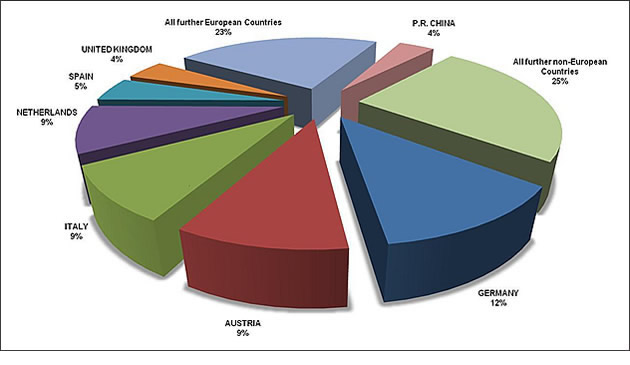
All Further "European Countries" includes: France, Greece, Finland, Sweden, Denmark, Belgium, Poland, Portugal, Switzerland, Norway, Lithuania, Latvia, Czech Republic, Hungary, Ireland, Luxembourg, Romania, Slovak Republic, Bosnia and Herzegovina, Cyprus, Estonia.
All Further "Non-European Countries" includes: Brazil, USA, South Africa, Japan, Canada, India, Turkey, Chile, Korea, Mexico, Thailand, Australia, Singapore, United Arab Emirates, Colombia, Hong Kong, Malaysia, Algeria,Egypt, Indonesia, Philippines, Iran, Nigeria, Argentina, Bangladesh, Iraq, Israel, Jordan, Pakistan, Paraguay, Russian Federation, Saudi Arabia, Sudan, Tanzania, Uzbekistan, Zambia.
The Call for Papers generated more than 870 contributions (abstracts) from 65 countries applying for presentation at the EUBCE Conference in Vienna, Austria, from 1 to 4 June 2015.
Proposals to present have come from the world`s leading biomass energy research, industry and market institutions and cover the entire biomass value chain, including the latest applications, market developments, as well as business, political and globalization considerations. There has been a particularly strong response to biomass potentials, gasification and pyrolysis, biorefineries and bioenergy environmental performances.
About 30% of the contributions have been submitted from countries outside Europe, confirming the trend towards further internationalisation. The Asia / Pacific region accounts for around 15% of the proposals. In addition, more abstracts than ever have been submitted from emerging markets from around the world, particularly from Africa.
The abstracts are currently being reviewed and scored by the International Scientific Committee made up of 150 leading research and industry experts from the global biomass sector.
Dr. David Baxter coordinates the Scientific and Industry Committees to set up a well-balanced Conference Programme of highest international standards.
Dr. David Baxter: "It is a pleasure once again to see such a big response to the call for abstracts. As you will have seen, the programme has been adapted slightly for the 2015 conference in order to cater for the gradual evolution in the biomass, biofuels, bioenergy and biorefinery communities. Over the years we have witnessed how the once separate communities have merged and become progressively more dependent on one another, and indeed benefitting from each other’s advances. This is true not only on a technical level but also geographically. Indeed, one new feature in 2015 conference will be one Topic on integration of technologies. I would like to take this opportunity to thank all contributors of abstracts and the members of the scientific and industry committees for their enthusiastic contributions".
The Conference programme will be published in February 2015. It is coordinated by the European Commission, DG Joint Research Centre.