


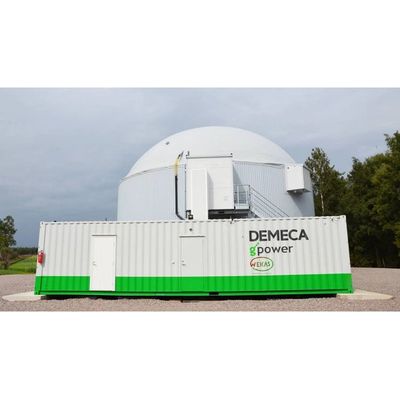
Demeca - Biogas Plant
Energy efficient Demeca farm biogas plant complete effective pre-treatment, which enables efficient and plentiful biogas production. Demeca biogas plants are made by modules and containers. Module biogas plant is possible to remove, transform and grow. Demeca biogas plant is tested with a cold and difficult circumstances in Finland. Biogas production is a significant advance on agriculture and cuts down greenhouse gases. Start biogas production with Demeca biogas plant and transfer your farm into the biogas era.
- CHP plant 50-200 kW
- Process volume 600-2800 m3
- Blade mixer (+propeller mixer)
- Energy efficient biogas plant
- Patented biofilter
- Biogasboiler 225-380 kW
Farm nutrient recycling
Enhance nutrient recycling on farms through manure processing and biogas production. The biogas process breaks down most of the nitrogen bound in proteins or mineralises into ammonium nitrogen, which can be more easily utilised by plants.
Self-sufficient energy
Self-sufficient energy production improves the predictability of business operations, increases the vitality of rural areas and reduces the use of fossil fuels.
Quality service
Demeca provides comprehensive services: Sales, production, installation, maintenance and spare parts services, design and product development. Our values guide our operations. We are familiar with farm operations and deliver biogas plants on a turnkey basis.
Biogas production takes place under the most visible part, the gas dome of the reactor, in an oxygen-free state and at a controlled temperature. Biogas production is a continuous process caused by bacteria that digest the feedstock. The digestion process produces biogas, which is mainly methane and carbon dioxide, as well as small amounts of other gases, such as sulphur compounds. The reactor’s patented biofilter effectively removes foul-smelling sulphur compounds that hinder further processing. Odours are reduced on the farm, as slurry is pumped directly into the biogas plant. Reactor technology and reactor operation affect the amount of gas obtained.
Kiintomädätys technology
Thanks to the Kiintomädätys®-technology, the biogas plant can use both wet and dry fractions as feedstock.
The main component of a biogas plant is slurry from production animals, and you can feed the biogas plant with, for example, over-yearly grass fodder, which is often difficult to dispose of. In addition, you can utilise external inputs, such as waste biomasses from the food industry.
The crude sludge is crushed to a smooth and liquid state with the Demeca Kaira slurry pump and pumped from the barn through a heat exchanger to the reactor. In the reactor, crude sludge and dry feeds are transformed into digestate, also called ”reject”.
gFeed - Dry feed pre-treatment
The dry fractions are pretreated in the plant’s gFeed unit by crushing and homogenizing with liquid fractions, after which the homogenised mass, which decomposes well in the bioprocess, is pumped into the reactor for digestion. The gfeed unit processes the dry feed, increasing the specific area of the plant parts, enabling efficient bacterial activity. Almost double the gas output can be achieved with solids.
When feeding dry feeds, it is a good idea to aim for a steady feed flow, so the gas yield can be influenced by storage methods on the farm.
Kaira slurry pump - Slurry pre-treatment
In Demeca’s solution, slurry is pumped to the biogas plant directly from the barn pump well, making the slurry as fresh as possible. The auger slurry pump together with the booster pump feeds sludge from the barn to the plant. The Kaira slurry pump homogenizes sludge and thus enhances gas production through a heat exchanger located in the plant space.
gPower - Electricity and heat production
The internal combustion engine uses gas as fuel and runs an electric generator, i.e. a biogas boiler (225-380 kW). In addition to electricity, waste heat and heat from exhaust gases are utilised from the generator. Additional heat can be generated by a gas burner in a separate heat boiler. Only water vapour and carbon dioxide are emitted. In addition to own use, it is possible to sell electricity produced to the national grid.
All plant main connections and equipment control are centralised in one space, where they are easily serviceable and accessible. The plant is connected to a remote access system and can be controlled and controlled from anywhere.
gFuel - Biogas upgrading
The 3-stage membrane upgrading of biomethane (50-100 Nm3/h) into vehicle fuel takes place in a separate Demeca gFuel unit. The gFuel unit will be located in the vicinity of the biogas plant.
gCompress - Biogas pressurize
After biogas refining, the gas is pressurised (300 bar) in the gCompress unit next to the filling station and stored in gas tanks, from where it can be refuelled directly to vehicles from the refuelling meter or sold in a gas container. The filling station, payment terminal and Tukes permits come from Demeca.