


- Home
- Companies
- Advanced Combustion Engineering
- Products
- Controlled Air Incinerators:
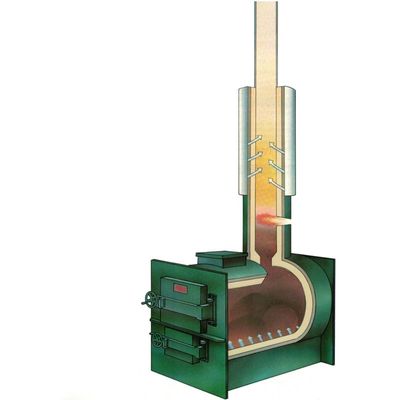
Controlled Air Incinerators:
Advanced Combustion Engineering `Controlled Air Incinerators` are primarily designed for batch operation with a burning cycle of approximately two hours and a cooling cycle also of approx, two hours, depending upon the density and calorific value of the waste. Unlike conventional multiple chamber incinerators which have large quantities of excess air, a controlled air incinerator uses less than the required quantity of air for complete combustion in the primary chamber. By starving the process, the volatile part of the waste is gasified and the combustible gas produces is mixed with air, ignited by a gas or oil burner and completely burned in the secondary combustion chamber or after burner chamber.
Fixed carbon waste burns in the primary chamber and provides heat for the pyrolysis process, so that energy from the waste is released throughout both incinerator chambers instead of mainly in the primary chamber as with multiple chamber incinerators. This eliminates the need for excess cooling air in the primary chamber and less auxiliary fuel is required in the secondary chamber.
The reduced quantity of primary air provides low gas volumes in the primary chamber with the result that the entrainment of particulates is reduced to a level where no auxiliary dust collector system is required.
Some of the main advantages of the `Controlled Air Incinerator` operated on a batch feed principle are:
PACKAGED TYPE MANUFACTURE
The basic design of a Controlled Air Incinerator with its primary chamber operating at a relatively low temperature and a smaller secondary chamber lends itself to `in factory` manufacture and testing, reducing costly on-site construction and its inherent problems. In-factory manufacture generally means considerable savings in initial cost.
REDUCED OPERATOR COSTS
The batch feed system requires the operator to be in attendance only when the incinerator is being loaded and during ash removal each morning.
The operator is thus removed from the responsibility of operation faults occurring as they often do in continuous feed multiple chamber incinerators, particularly when the waste is highly volatile, such as when plastic is included.
PREFABRICATED IN WORKSHOP
The Controlled Air Incinerators are pretested prior to delivery and designed to be readily transported and can be installed and commissioned within a week of arrival on site.
REDUCED STACK EMISSIONS
With the batch feed system where the operator loads the incinerator in a `cold` condition the fire bed is not continually disturbed by loading and agitation. Hence the carry-over of particulates is reduced and there is often no need for a large secondary combustion chamber or for dust collection equipment.
Smoke density levels can easily be met even when burning high proportions of plastics or rubber because of the primary combustion air restrictions. In a multiple chamber incinerator these are extremely difficult to maintain even with the most skilled operator, so additional temperature control methods are incorporated.
REDUCED AUXILIARY FUEL REQUIREMENT
The starved air principle of combustion distributes the heat released from the waste over the entire incinerator. This reduces substantially the fuel consumption of the secondary burner.