


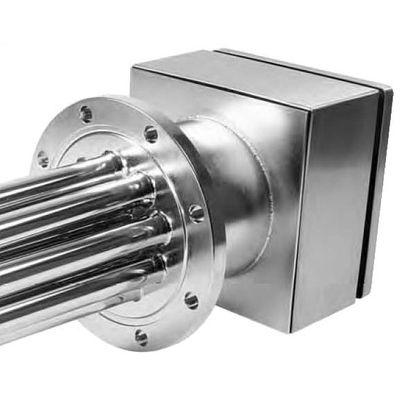
Heatsystems - Electrical Flange Heaters for Heating Liquids or Gases
Electrical flange heaters are designed for the efficient heating of liquid or gaseous fluids, whether they are flowing or stagnant. These heaters work by converting electrical energy into thermal energy through heating rods, which then transfer the heat directly to the fluid. The heaters can be customized to suit the specific properties of the fluid being heated, taking into account factors such as fluid type, pressure, and temperature conditions. They are available in various designs, including explosion-proof models. Heating elements can vary in speed and mechanical properties, and configurations can be adjusted for control using internal or external switchgear. Components that interact with the fluid are selected based on the fluid's properties to prevent corrosion. Additionally, the design of the flange heater can be tailored to meet specific application requirements, with available customization options for flange connections and insulation, particularly in conditions requiring freeze protection.Electrical flange heaters are designed for efficiently heating liquid or gaseous fluids which are flowing or stagnant. The design is based on the general conditions such as the type and properties of the respective fluid, pressure and temperature as well as the desired operating points in the process.
Electrical flow-type heaters directly heat fluids, converting electrical energy in the heating rods to thermal energy. The thermal energy is then transferred from the heating rods to the fluid. Here, it is important that the design be matched to the general conditions, for each fluid has its specific properties.
For example, these fluids are heated in electrical flange heaters:
I. Water
- Drinking water, max. surface load depending on the water hardness 4 – 6 W/cm²
- Circulating and/or heating water, max. surface load approx. 10 W/cm²
- Softened water; observe the maximally admissible chloride content, max. surface load approx. 19.0 W/cm²
- Ultra-pure water; here, a low-pocket or pocket-free design with a defined surface quality is useful in most cases.
- Fully desalted water; here, non-ferrous heavy metals should not be used, maximum surface load approx. 10 W/cm²
II. Oil
- Heavy oil, not pumpable in a cold condition, maximum surface load between 1 and 2 W/cm² depending on the quality
- Hydraulics oil, maximum surface load approx. 0.6 – 1.2 W/cm²
- Lubricating oil, steam turbine oil, max. surface load approx. 1 W/cm²
- Insulating oil, maximum surface load approx. 0.3 – 0.6 W/cm²
- Heat transfer oil, film temperature calculation acc. to DIN 4754 required, maximum surface load approx. 10 W/cm²depending on the flow velocity and oil
- Fuel oil, diesel, heating to max. 40 °C, max. surface load approx. 4 W/cm²
III. Gases
- Air
- Natural gas
- Flue gas
- Nitrogen
- Steam for overheating
IV. Other fluids
- Bitumen (attention when melting: bitumen will expand strongly.)
The fluid to be heated and the application temperature mainly define the materials which can be used for the unheated and/or heated surfaces. Otherwise, corrosion may quickly result in a failure of the electrical flange heater, for example.
Materials of the wetted and unheated components:
- Carbon steel
- Corrosion-resistant stainless steel
- Heat-resistant stainless steel
- Titanium, Hastelloy, special materials
- Brass
Materials of the heating surface:
- Carbon steel
- Corrosion-resistant stainless steel
- Heat-resistant stainless steel
- Titanium, Hastelloy, special materials
The design of the individual heating elements is a function of the application. There are faster or slower heating elements, mechanically robust or more filigree designs. Also, a distinction is made between compacted heating elements and heating elements where the internal heating insert can be replaced without the necessity of draining the fluid.
I. Heating elements
- Tubular heaters, diameter 8.5 or 16 mm
- Cartridge-type heaters, diameter 16, 18 or 25 mm
- Exchangeable heating elements, including a protective tube, diameter 25, 42 or 65 mm