

- Home
- Companies
- Waste To Energy Generating
- Products
- Electricity Generator
Electricity Generator
We would like to present a completely new innovative breakthrough technology for generating electricity and cold from low-potential renewable and waste heat energy. Our technology is based on an absolutely new absorption cycle, in which, unlike others, the generation of electricity is realized even at negative temperatures below the ambient level. Highly cost-effective autonomous power supply systems of various capacities can be created in that case even at using temperatures of 50-60° C. The process provides locally distributed and off grid decentralized cooling and energy generation. The technology is applicable for power supply to individual and industrial consumers.
Our company is developing industrial energy plants, that produce electricity and cooling from ultra lowpotential waste heat. Our technology usues our own brand new thermodynamic cycle based on a single heat engine (expander) and it converts waste thermal energy into electrical energy and cooling.
Our solutions can help any traditional power plants and other customers to increase efficiency by 25-30%.
We completed 70% of R&D and created a small prototype with capacity 1kWt. At this stage of our project we are looking for investments to finalize R&D procedures and to set up pilot projects with capacity 100-150 kWt. We see a great interest from our partners from the UAE and South Korea who are ready to provide sites for testing and operating pilot projects.
One of our companies – `EnTech LLC` Russia was a resident of Skolkovo Innovation Center Russia, http://sk.ru/news, it confirms the incredible level of interest to our solutions.
A new absorption cycle of try generations is proposed.
The working fluids used here are solutions of low-boiling component (refrigerant) and high-boiling component (absorbent).
The cycle, as shown in Figure 1, includes an expander (turbine) 1 and a chemical compressor consisting of an absorber 2, a pump 3, a solution heat exchanger 4, a steam generator 5, separators 6, 7 and a cooler (heat exchanger) 8.
The expander is connected on one side to the steam generator (boiler) and the other to the absorber and the heat exchanger (cooler).
In this case, the refrigerant vapor is released from the strong solution at its heating before the turbine and is absorbed by the weak solution after the turbine at its cooling.
Thermal energy is released into the absorption process and the temperature of the working fluid rises.
The cycle has a two-stage regulation of the composition of the working fluid in the separators 6, 7, and its absorber is equipped of a liquid-steam ejector.
These features of the cycle make possible to generate electricity and cold with using only one heat engine (turbine) since the cycle has an extended useful temperature range.
Highly cost-effective autonomous power supply systems of various capacities can be created in that case even at using temperatures of 50-60° C.
In countries with a hot and humid climate, this technology allows in addition to electricity and cold, to generate a significant amount of fresh water by condensing its vapors from the air.
Local energy sources, such as biomass, solar, geothermal energy, industrial heat waste and the like can be successfully used in this case. Environmentally friendly refrigerants and their absorbents can be used as working body.
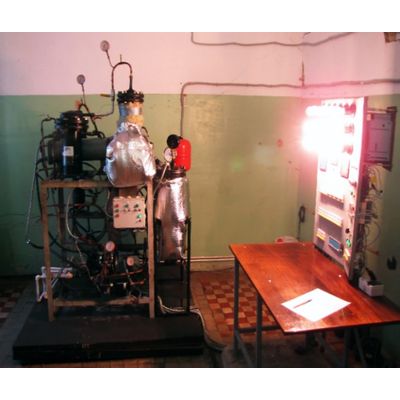
The experimental technology studies using a laboratory installation with a power of approximately 1 kW (Figure 2.) show that the technology can be implemented in a relatively short time even with the current state of the art.
The proposed technology allows to significantly increasing the efficiency of generation of electricity, heat and cold from renewable or secondary energy sources and opens up fundamentally new prospects for the further development of clean energy.
The new absorption cycle to generate of electricity and cooling, in unlike to the known ones, has a number of characteristic features:
-
The generation of electricity and cold is carried out in one heat engine, the expander, at low temperatures, for example, at temperatures from plus 50 to minus 40° C, while the release of the heat at closure of the cycle takes place in the absorber at a higher temperature, for example +30 + 40°C;
-
To improve efficiency in the cycle, there is a two-step regulation of the strong solution concentration, the first of which is carried out by a separation or a filtration, and the second by the evaporation.
-
In addition, for the same purpose, the pressure of the exhaust steam after the expander is partially increased by the use of liquid-vapor ejectors using the solution as an injection fluid.
Such technology is fully environmentally friendly, increases the efficiency of generating energy from renewable or waste heat sources by more than 2 times (from 10-12% to about 20-25%) compared with a similar ORC cycle and can have very wide application.