


- Home
- Companies
- Energie Energia Solar Termodinâmica
- Products
- Aquapura Split - Heat Pumps for ...
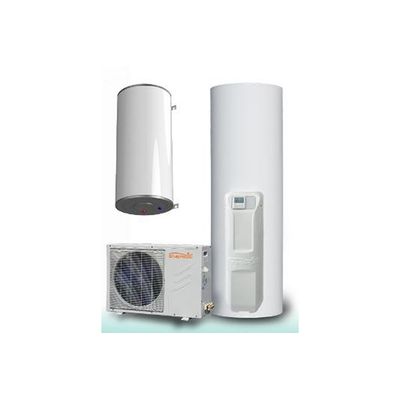
Aquapura Split - Heat Pumps for Demestic Water Heating
Small space required. Only the cylinder stays inside the house. Absolute silence inside your home. Various capacities, models with and without coil.
The heat in the environment is indirect solar energy, stored in water, air and soil. The heat pump will remove heat precisely from these heat sources to later be used for heating your home.
The AQUAPURA SPLIT high efficiency heat pump for Domestic Water Heating (DHW) is a modern solution, efficient, and clean solution that guarantees the comfort of your home, while always respecting the environment. A smart way to use Nature`s resources in order to improve your quality of life. With this solution, you will be making a serious commitment to the reduction of harmful emissions into our atmosphere, thus contributing to the planet`s natural balance.
The AQUAPURA SPLIT heat pump for Domestic Water Heating (DHW) has been developed to respond to both domestic and industrial use, i.e. for hot water consumption in facilities such as Hotels, Guest houses, Hospitals, Gyms, Etc.
The heat pump for AQUAPURA SPLIT is direct-contact condenser technology.
It has two parts: Split-system heat pump which is installed outdoors DHW heater installed indoor
The interconnection between the two parts is done with refrigerating connections (up to 20 meters).
The AQUAPURA SPLIT can be used at outdoor temperatures of up to -15ºC, allowing for the production of domestic hot water up to 65ºC just with the compressor, which allows for direct replacement of the existing electric cylinder or water heater.
Heat pumps are systems that use the principle of thermodynamics to extract natural heat from ambient air into your home. ENERGIE heat pumps are the ideal solution to increase energy efficiency, taking advantage of the environment as the main source of energy.
There is a cooling liquid that is pumped to an outdoor heat exchanger (evaporator). Here the liquid, with the help of a fan, absorbs the energy from the atmosphere to the temperature differential obtained outdoors. During this process, the liquid changes to a gaseous state. The gaseous state is sucked in by the mechanical part of the system, the compressor. Here it is compressed, the pressure goes up and consequently the liquid temperature increases. After this, the liquid travels to a second inside heat exchanger (condenser) and transfers heat to the water in the cylinder. The fluid goes into liquid state by cooling down. The liquid pressure is reduced due to a strangulation that happens in the expansion valve and the process starts again.