

- Home
- Companies
- Suntactics
- Products
- Suntactics - Model sTracker - High ...


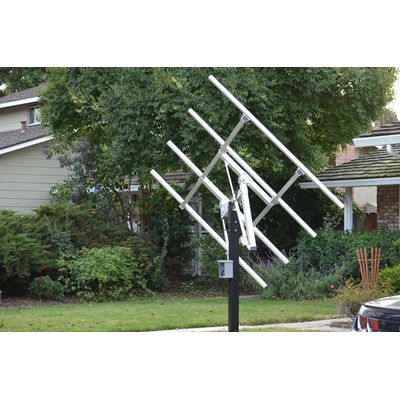
Suntactics - Model sTracker -High Efficiency Dual Axis Solar Tracking System
The sTracker is a high efficiency low maintenance ground mount dual axis solar tracking system. Solar tracking aims solar panels at the sun all day long for maximum sun exposure. Solar absorption from dual axis tracking is proven to produce near twice the solar production per day.
The sTracker is engineered to withstand the most extreme environments using high strength aluminum and steel. It is manufactured with CNC machining, precision lasers and welded framing. The sTracker also includes standard Ironridge XR100 rails which makes it compatible with many standard solar panels. The control system provides accurate tracking and is configurable. Linear actuator motors provide the movement and require very little power.
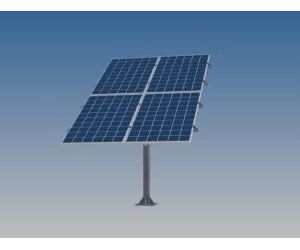
The sTracker supports four standard panels. If you need more power, just add more solar trackers.
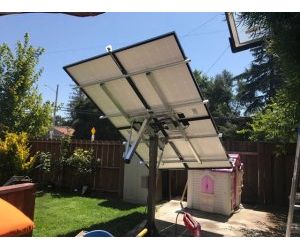
Includes:
- Complete Solar tracking structure(Including post)
- Mounts 4 large solar panels
- "Ironridge x10" solar panel rails
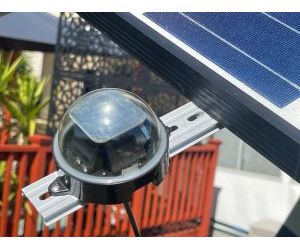
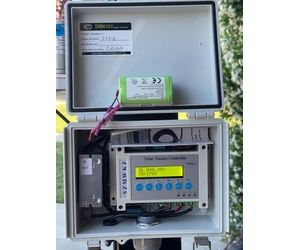
- Smart tracking control
- Stainless hardware
- Steel post
- T-6061 Welded Aluminum Framing
- Pre-wired simple harness
- Lion power drive battery
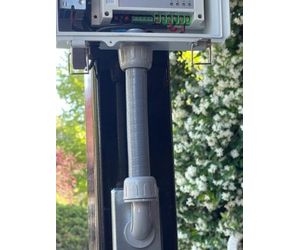
- Waterproof Enclosure box
- Two heavy duty, low power, actuator drive motors
The sTracker is perfect for property owners with some land and space. Solar panels work at optimum when they face directly at the sun using solar tracking obviously. With this in mind, here are some uses.
Air conditioning:
Right about the time when your house is 90 degrees at 3 PM, your power company is charging you a premium. But guess what, a solar tracker is producing MAX power at 3PM in the summer. All the way to sunset!
Pool pumps:
We have customers that have been very happy with all day power using our solar tracker to power their pool pumps.
Charge your Electric Vehicle:
Charge your EV all day long. If you work at home, this is a no brainer. Electrical and fuel cost are not going down so if you plan to buy or own an EV, using solar tracking goes hand in hand.
Charge backup batteries:
If you are totally frustrated with your power bill and had enough, use batteries for storage and claim independence from your power company.
Complete off grid:
Batteries are the key. Solar tracking can keep your batteries charging all day long. Your batteries will be topped off! Then you can run off an inverter throughout the night. There are many options and applications with off grid and solar tracking.
Agriculture and Farming:
Running pumps, lights and fans take huge energy. Solar tracking can produce energy all day long. You can also Integrate the sTrackers within your crops with a very small footprint. A win, win situation.
Environmentally Conscience:
We have a star, our sun, that is a fusion reactor producing massive amounts of energy. We strive to grab up all the energy we can to survive. Aiming a solar panel at this massive reactor in the sky pulls in great electrical energy and reduces our consumption of precious resources.
The sTracker is considered a ground mount system but produces more power than the typical stationary ground mount system at near the same cost. The sTracker also reduces the amount of panels needed. Typical ground mount racking and frames add to the cost and also require even level surfaces. The modular design of the sTracker, it can be placed on most all terrains, slopes, and surfaces. An sTracker can quickly be erected once the base is in place using either a concrete hole/pier, a concrete pad or existing pad. We offer stamped structural documents so you can get a per.
If you are a solar contractor, we are looking for installers. We receive many inquiries for installing our solar trackers. We will send them your way. Contractor form
Do you want to be a distributor? We may be interested. Our sTrackers are manufactured in San Jose CA. Our manufacturing facilitates high quality, high throughput and top notch solar tracking engineering. We can supply and ship in volume. Please contact us for volume pricing.
Our solar tracker business is gaining a lot of traction these days with larger orders. But we are still willing to offer the DIYer for the time being.

One tracking system can produce over 12 kWatt/hours a day in mid to southern latitudes spring to fall. Depending on your situation, payoff times can be as low as 3 years. The sTracker can mount up to 1.6 Kwatts of solar panels using the current panel output technology. This equates to 2.2 kWatts because it is tracking producing 40% more solar power. Add more trackers for even more power.
We get the question if our tracker can mount more than four panels. The reason we use only four panels is it`s easier to maintain. And we can use many "Off the Shelf" components. A larger tracker adds more complexity, high installation costs and higher maintenance. The solution for more solar tracking power is to add more Suntactics sTrackers. Simple.


Solar Tracker Frame
- Micro processor tracking control configurable
- Low consumption drive powered from solar
- Coated steel post
- Ironridge panel railings compatible with all standard solar panels
- Durable T-6061 aluminum framing
Advantages
- Accelerated return on investment
- Easy reach for cleaning
- Good air flow lowers panel temperatures for more power
- Small footprint
- Charges solar batteries all day long
- Panels easily removable for hurricane prepping
- Full customer support
Other Features
- Professionally certified to 110 Mph winds, Snow, and Seismic
- Warranty: 10 years
- Worry free maintenance
- 26% Federal tax credit 2022
- Semi portable, take it with you if you move
- Full portability option
- Manual override to flat position for high wind conditions
Suntactics Solar Tracker Specifications
- Panels Supported: 4
- Panel dimension contraints::
- Standard Panel: < 74"" x 41" 1700mm x 1040mm
- Large Panel: > 76" x 41" with extension kit
- Tracker Frame Weight : 165 lbs
- Tracker foot print: 12 ` x 7`
- Post Height: 67 inches
- Structure metal: T-6061 Aluminum frame, Steel Post with mounting plate
- Fasteners: Stainless steel rust proof
- Solar Railing: Ironridge brand solar panel railings
- Post Foundation Recomendations::
- Concrete Hole: Depth : 3-4 feet, 5 Feet in colder ground freeze climates
- Concrete Hole: Width: 18-20”
- Concrete Pad: 6`x 6` x 6" with outer skirt depth 6" , rebar 1 ft square
- Hazardous Conditions Certified::
- Wind Resistance: Certified, 120 Mph
- Earthquake : Siesmic certified, Yes
- Snow bearing load: Certified, Yes
- Actuator Power Consumption: 1 Amp momentary per tracking cycle (.5 Amp average)
- Actuator backup battery power: 1.3Ah Solar assisted charging
- Linear Actuator Axis 1 spec: 1500N(350lbs), 14" stroke
- Linear Actuator Axis 2 spec: 1500N(350lbs), 18" stroke
- Solar tracking electronics: Light sensor, Computer MCU, configuration display
- Azimuth Tracking range: 60 degrees West, 60 degrees East
- Altitude Tracking range: 40 degrees Down, 100 Degrees up, adjustable
- Morning reset: Yes, adjustable, factory preconfigured
- Cloud chasing suppression: Yes, adjustable, factory preconfigured
- Aiming calibration: Yes, adjustable, factory preconfigured
- Federal Credit Discount Qualified: 26%
- V1.3 07/12/22: SolarTrackerInstallationData/Specifications
There are basically 4 items that can determine a reasonable estimate on solar payback time. This is both for tracking and fixed systems and this is based on 2018 figures. Electrical costs are much higher now.
- System costs and installation
- Tax breaks and rebates
- Price per kWh’s
- Total kWh’s the system can produce yearly
“kWh’s" (Kilowatt hours) is the rate of energy you consume in a given amount of time. For example: 3000kWh/year, 400kWh/month or 20kWh/day to give an idea.
Solar production estimates are sometimes based on a yearly average (more in summer, less in winter). If you live in a hot climate and run the AC all day long, the solar tracking payoff time becomes shorter. This is because you are receiving optimum solar when you are consuming the most power.
Price per kWh value is stated on your monthly bill. If you are paying lower than $.10 kWh, solar may not be justifiable unless you are using large amounts of energy in kWh’s per day.
Some Power Companies use a Multi-tiered and Peak-usage Approach
The peak usage program increases the cost around 3:00PM and just about the same time people get home from work. A static installation stops producing full power about 3:00PM. But with solar tracking, full power production continues until evening.
There is also another program called "Demand Charge". This term is a sore subject with the farming industry that depend on irrigation pumps and other high consumption electrical. This is a complicated topic meant for another discussion. So let`s move on for now.
In San Jose CA, the power company uses a multi-tier program. Currently, Tier 1 - .19kWh, Tier 2 - .27kWh, Tier 3 over .30kWh! They move you up a tier based on your usage. After 300kWh/Month usage they move you to Tier 2 and so on. This becomes very expensive especially if you are running an AC or even charging an electric vehicle when peak usage kicks in. However there are some incentives with EV charging and the power company may reduce power costs.
The total usage you consume in kWh’s is another consideration for your solar investment decision. Over 400kWh’s/month is pretty high and you should consider going solar. Plain and simple.
Power Companies do not Like Solar
They say they do, but they don’t. Power companies continue to find loopholes that make your solar system less useful. It hurts their bottom line. Like we mentioned, some electrical companies impose a high demand/peak pricing program. This can range from 3PM-8PM. This about the time solar becomes less productive for fixed solar installations. And about the same time peak usage goes up. Sure, you may receive net metering credits from solar but there is a commission involved. You do not receive back the total credit of what you gave to them. You can save the solar power for yourself by using solar tracking that continues to produce all the way into the evening when demand is at most.
If you don`t have solar, at least take measures to reduce high power consumption in your home. But it is hard to do especially if you need to use air conditioning.
What is the Payback Time in Years Using the Suntactics Solar Tracker?
To figure out payback, you will need the 4 the items mentioned:
- System costs and installation
- Tax breaks and rebates
- Price per kWh’s
- Total kWh’s the system can produce yearly
In the solar tracking case, we will base it on one solar tracker that produces 1.2Kwatts. For the sTracker, this is the final output after panel and inverter inefficiencies and power losses through wiring and other electrical connections. There are some other inefficiencies but they are very small. You may say 1.2Kwatts is not enough solar energy for my situation. This is true but it is pretty much linear. Use 2 solar trackers or 3 to get you to your power requirements.
Let’s do a solar payback example for the solar tracker:
- System cost rounded off to $5000. After the 30% Fed credit = $3500. Lets’ be conservative and make it $3800(installed).
- Price per kWh in the San Francisco Bay Area is about $.24kWh on average as of early 2018.
- Total yearly average in Northern CA with a 1.2Kwatt solar tracker is about 3000kWh’s/ year.
Payback estimate in years = Total cost / ( Price per kWh * Yearly solar production kWh’s)
Payback estimate in Years = 3800 / ( .24 * 3000) = 5.1 Years.
The same example using a fixed or roof system:
Now this gets a little tricky. A solar sales person may state the solar power offered is 1.2KWatts but may not state the actual power output after all the inefficiencies in the system. You need to bring this to their attention as it may affect their payoff estimate. They may be surprised that you are educated. But most reputable solar companies will know about system inefficiencies and will state the true output. So we will treat this example as 1.2KWatts output after the inefficiencies.
- System cost as stated in first example $3800 (After rebates, installed).
- Price per Kwh in the San Francisco Bay Area is about $.24kWh on average.
- Total yearly average with a 1.2Kwatt fixed system is about 2100kWh’s/ year.
Using the same formula as the solar tracker:
Payback estimate in years = Total cost / ( Price per kWh * Yearly solar production kWh’s)
Payback estimate in Years = 3800 / ( .24 * 2100) = 7.5 Years.
The solar tracker payback is 5.1 years and the fixed system is 7.5 years. Solar tracking produces a substantial amount more power over a fixed system. Fixed systems are wasting precious potential solar energy. However, a fixed system may be the only choice for you for many reasons. You may not have the room. But we are all in this together, fixed or tracking, both save money either way.
How We Determined our Findings
We used many sources to come up with our calculations. We used PVwatts, other solar calculators, input from our solar contractor connections and distributors. We also continue to test using real life solar data and measurements.
Price per kWh’s data are given to us from property owners in the area. Some of the billing statements revealed lower than .24 kWh pricing, but most were over. Some were even higher than .27 kWh pricing. As described earlier, California uses the multi-tier program. The more you use, the more they take.
We can give you a pretty close estimate on solar payback time provided you have the price per kWh and total kWh usage. If your state offers solar incentives, this will also help with the pay back estimate.
Power in Watts
Solar panels produce power from the sun, yes we got that part. But what does power actually mean with solar output? Power is measured in Watts. As you know, light bulbs are also measured in Watts. Say a light bulb consumes 40 watts and one solar panel produces 300 watts. 300/40 = ~ 7 bulbs. A 300 watt solar panel provides power for seven 40 watt light bulbs.
Power in Kilowatt / Hours
This part will hopefully educate you a little before the high pressure pitch you will receive from the typical solar company? But you must understand first what a Kilowatt/Hour (kWh) means. This will help you tremendously with the jargon.
So what is a kilowatt/Hour? It is an amount or rate of power that a power source (i.e. solar or grid) will produce in one hour. The 40 watt light bulb consumes 40 watts. But it also consumes 40 watts per hour. In ten hours, that little 40 watt light bulb will have consumed 400 watts in ten hours or 400 watt/hours (40 watts x 10 hours). When you add more electrical stuff, fridge, washer, hair dryer etc, it gets into the thousands of watts used. This is why we use Kilowatt/Hours(kWh) as a measurement. After adding up all the electrical appliances, it can go over 5,000 watt/hours! Instead of using 5000 watts, we use 5 kilo watts. For example, 15,500 watt/hours = 15.5 kWh.
The electrical companies charge you on a kWh bases. So if you have used 400 kilo watt hours of electricity in a one month billing cycle, your will be charged for every 1kWh used. The price per kWh can vary from.10-.30 cents per kWh.
On average, a 2000 Sq ft home consumes 30 kWh a day. So if your panel produces 10 kWh a day, then you reduced your consumption from 30 kWh per day to 20 kWh per day.
What a Solar Tracker Can and Can Not Do
The solar tracker can produce up to 40% more kWh`s per day than a static, non moving, panel. A solar tracker faces the sun directly all day. A solar tracker even adjusts to the seasons for optimum output. But a solar tracker needs room with no obstructions to work at its best.
A Note About Roof Solar
If you place a solar panel on a roof, it`s highest output will be in a 4 hour range when the sun is high up. If you have a roof with multiple small faces, you will need to add panels on all the faces to get optimum exposure. This is a good solution, but adds more panels none of which will produce at full power at the same time. For instance, if you have three faces on the roof in East, West, and South directions but only have room for a few panels on each face, you will need to place panels on all faces. Each set will get sun. But when the sun is directed to the East panel array, the West array will be dormant. Regardless, this may be the only choice, unfortunately it comes with great cost too. Solar panels need to face the sun. Beyond 30 degrees trajectory, they drop in power significantly. In low season, panel production decreases as well.