

- Home
- Companies
- Hydrodrive Systems & Controls PVT Ltd
- Products
- HydroDrive - Electronic Catalytic ...
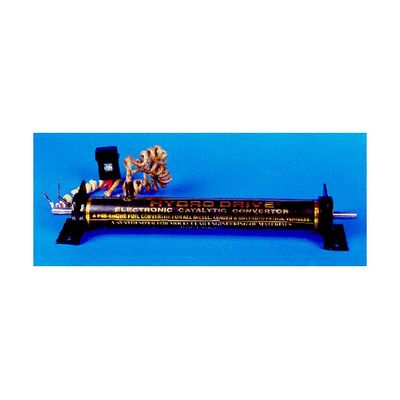
HydroDrive - Electronic Catalytic Convertor
A pre-engine/pre ignition device used to control the exhaust emissions through combustion kinetics change in all internal combustion engines using diesel, bio-diesel, leaded ,unleaded petrol, kerosene, gaseous fuels, including blended/emulsified fuels and also used in the gas turbines and all external combustion equipments-boilers, furnaces, room heaters etc.
ELECTRONIC CATALYTIC CONVERTOR COMPRISES OF:
An open ended fuel passage cum nano wire wave guide for obstruction free fuel flow in the fuel system, a co-axial resonator made of nano structure/nano wire wave guide mechanisms for propagation and transmission of one or all waves-microwaves, photon emissions, sound waves, surface waves and other types of waves including electrostatic ion-cyclotron waves, Alfen waves, quantum waves in the presence of a transverse direct current electric field in a magnetized plasma through the wave guide and/or the resonator to excite the electrons of the fuel molecules when any of the waves are generated by a power source or by the 12V /24 V D.C battery of the vehicle /engine .
CATALYST IN THE ELECTRONIC CATALYTIC CONVERTOR:
Are the "ELECTRONS" due to "RESONANT CAPTURE" doing "ENERGY CATALYSIS/PLASMA CATALYSIS" when the atoms and molecules of the fuels are electronically excited during their metastable state. Particles in electronically excited states do not directly participate in the act of chemical interaction but serve only as agents that transfer energy from the electron gas of the discharge plasma to the molecules to be activated, thereby facilitating the formation of activated states. The difference from ordinary catalysis consists in the attainment of higher equilibrium (equilibrium-stationary) concentrations of the reaction products under the action of energy catalysts. In energy catalysis, it is not always necessary for the atoms and molecules to play the role. The analogous function can also be fulfilled by the electronically excited states of the reaction participants themselves which transfer energy by means of collisions of the second kind to similar molecules or to the molecules of the other participants of the reaction as in the synthesis of ammonia. In other words, collisions of the second kind, and also by other means, there may appear molecules in a state of close dissociation i.e. at high levels of vibrational excitation making them chemically active.
ELECTRONIC EXCITATION IMPROVE FUEL QUALITY, CHANGE PROPERTIES AND KINETICS OF BURNING FOR A CLEAN COMBUSTION:
The heat capacity values Cp and Cv change with internal rotations and torsional modes of the molecules under excited conditions making changes to the ratio of specific heats which influence any heat engine`s cycle of operation. Further, the fuel is partly ionized and REFORMULATED with changes in volatile fraction volumes and altered molecular structure. The charge distributions alter the rotational energy, vibrational energy, translational energy and electronic motions that contribute to the total molecular energy level of the fuel. The charge distributions contribute to new chemical effects altering the kinetics of the combustion process. The HYDROGENOLYSIS by the metastable hydrogen under excited conditions reacts with the low concentration sulfur in parts per millions to form oxides of sulfur and adsorbtion of sulfur in the metal semiconductor layer serving as a further catalyst for oxidizing the fuel on board the vehicle or inline at an economical cost avoiding costlier refinery processes for fuel quality improvements.
CONTROL OF COMBUSTION PROCESSES BY SELECTIVE EXCITATION OF INTERNAL DEGREES OF FREEDOM OF THE REACTING MOLECULES:
The additional production of atoms/radicals at the initial moment can significantly decrease the "Ignition Delay". On the other hand atoms and radicals can influence significantly the "Kinetics of Combustion".
ENGINE PERFORMANCE IMPROVEMENTS:
The Electronic Catalytic Convertor cum Fuel Synthesizer improve fuel spray, vaporization, atomization of the fuel in the common rail diesel injection system (CRDI) due to fuel excitation while the microwave plasma assist clean combustion. The changes in the " KNOCK LIMIT " and " LEAN LIMIT" due to " REDUCED IGNITION DELAY " of the fuels in REAL TIME due to EXCITATIONS altering the kinetics of the combustion process facilitates enhanced engine performance, reduced emissions and improved fuel economy which a conventional exhaust catalytic convertor fail to offer.When used along with a conventional exhaust catalytic convertor, it facilitates moving towards zero emissions in gasoline engines tuned towards lean mixture.
With diesel engines, reduces the smoke and suspended particulate emissions by over 60%. In general, the microwave heating melts the wax, sulfur for full combustion and changes the viscosity and density of the diesel under magneto hydrodynamic flow conditions. The wax and sulfur in melted conditions flows freely without clogging the diesel injection nozzles and maintains the original diesel spray pattern within the combustion chamber which worsens with usage otherwise. The microwave and other field effects alter the surface tension of the fuel droplets for enhanced combustion and facilitates use of EMULSIFIED FUELS a practical reality for elimination of NOx emissions in the diesel, gas turbines, boilers and all external combustion systems. The peak cylinder pressure and peak cylinder temperature are reduced .This is reflected in the smoothness of the engine operation with enhanced power and pick up and extension of the slow speed limit in the top gear avoiding frequent gear shifts. In all engines, the soot within the combustion chamber is automatically decarbonaized in about 1500 kilometer of vehicle run after fitment The combustion chamber is always kept clean to avoid loss of compression.
HYDRODRIVE`S FIELD RESULTS ARE NOW SUPPORTED BY RESEARCH CONFIRMATIONS:
Combustion research facility of the U.S.Govt`s -Sandia National Laboratory, Livermore, California have confirmed that early injection advance totally changes the combustion kinetics and offer less NOx and soot free exhaust and is more beneficial.
As an APPRECIATION OF THE RESEARCH WORK done by the researchers and to facilitate all engines/vehicle manufacturers, leading fuel system manufacturers to make use of the early injection concept now made a reality and workable through the use of the patented (rights protected in several countries) HYDRODRIVE`s ELECTRONIC CATALYTIC CONVERTOR cum ONBOARD ALL FUEL SYNTHESIZER.
ELECTRONIC CATALYTIC CONVERTOR
- Pre-engine/Pre-ignition Convertor .
- Cleans the combustion process.
- Improves fuel properties for better combustion.
- Works with all fuels.
- Decarbonaizes engine combustion chamber.
- Reduces engine noise and improves engine smoothness.
- Enhances fuel economy in actual driving conditions.
- Works on Microwave electronics, Plasma Chemistry.
- No noble metal substrates or chemicals used.
- Engine pick up improves. No back pressure to engine.
- Same size for all fuels and engines of any cubic capacity.
- Slow speed driving range in top gear enhanced.
- Economical and easier retrofit. Fitted within an hour.
- Powered by 12V D.C. vehicle`s battery. With 24V battery, a
- 24 V DC-12 V DC convertor is required.
- No warn up time required.
- Reformulates fuel to increased Octane and Cetane value