


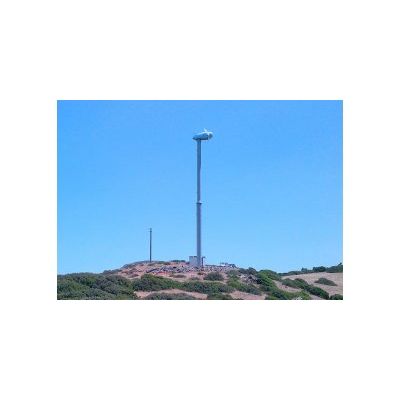
Libellula - Model 55+ -Robust Wind Turbine
Libellula 55kW is a simple and robust turbine that can reach up to 57 kW. It is conceived in the same manner as large, high-power industrial installations and is equipped with an active yaw system with gear motor, professional wind direction and wind speed sensors, and load-bearing tubular tower with internal ladder. The peculiarity of Libellula 55kW is to have one main generator for energy production and one auxiliary generator for grid connection; while mechanical power limitation is obtained by means of a well proven passive blade pitch adjustment, electrical power regulation is carried out with an unconventional inverter/rotating-converter combination. This converter system allows the main generator to rotate at a variable speed, while the grid connected generator rotates at constant speed, as for the conventional stall regulated wind turbines with asyncronous generator directly connected to the grid.
This brochure describes the characteristics and main components of the Libellula 50/55kW wind turbine.
Developed from a well proven technology that has been applied in hundreds of installations functioning in Northern Europe, Libellula 50/55kW is equipped with a large diameter 2 blade rotor with a new patented energy conversion system.
This wind turbine is designed with simple straightforward concepts:
- it is mostly built with standard industrial components
- transportation is carried out by one standard truck
- it is installed by one crane (lifting basket not necessary)
- it connects to weak electrical grids
- maintenance is possible inside the nacelle without using a lifting basket
Libellula is a small size wind turbine, but it is conceived like big size industrial installations, as it is supplied with a gear-motor yaw-system, professional wind vane and anemometer, self-supporting tubular tower with internal ascent and accessible nacelle for maintenance.
Libellula is available with different tower heights and with 50kW or 55kW rated power, according to model.
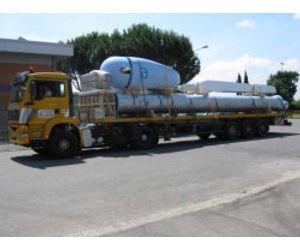
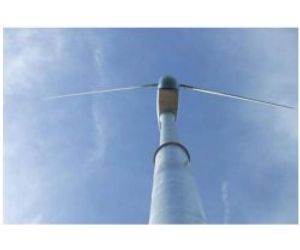
Libellula 55kW is provided with a large diameter rotor in comparison to its nominal power; with a swept area of 254 m2 it captures 5 times more wind than a 20 kW medium size generator equipped with an 8m rotor.
The specific swept area is particularly high (Sa=4.63 m2/kW) compared with standard big size wind turbines (normally about 2.50 m2/kW) and this allows it to grant an average production of 30-50% higher than the figures that are published on the Wind Atlas.
This feature is particularly advantageous at less windy sites.
The Libellula 55kW variable rotation rotor features hinged mounted blades and a passive pitch control system.
The flexible blade mounting system allows small angle forward and backward blade oscillation which eliminates all asymmetrical loads on rotor axis much more effectively than with stiff three blade rotors.
During operation the pressure of the wind pushes the blades backwards in the direction of the main shaft with a certain angle. The rotation speed of the rotor causes centrifugal forces which tend to cause the blades to stretch out and come forward reaching a level of intermediate balance. This slight ongoing adjustment follows the effects of wind variation in time and space so that the forces involved have no effect on the rotor axis or on its supports.
The pitch is very important for the adjustment of the power that is generated. This passive system is operated by mechanical and aerodynamic forces so that it is totally independent from the electronic adjustment system, thus preserving its functionality even without electrical power.
The blades are designed so that at the increase of wind and rotation speed, the blades tend to increase the pitch with increasing force; a spring-loaded system counteracts this force. With wind speed not exceeding 11 m/s the force does not change the pitch which remains steady at the figure that is most favorable for the operation of the turbine. In this condition the variable rotation speed of the rotor allows to optimize electric energy output.
With wind speeds above 11 m/s the force will cause activation of the pitch adjustment system, steering them as to maintain rotation speed under control even when the available wind power greatly exceeds the power absorbed by the turbine.
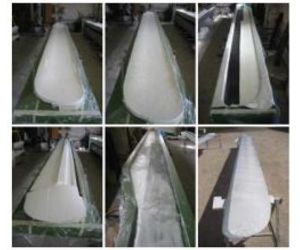
- The blades are made of glass and carbon-fiber reinforced epoxy; the insides are hollow and filled with expanded material. Due to these components the blades are light, strong and flexible.
- The blades are based on the NLF-416 profile. They have a tapered form and a slightly twisted chord. The length is 7.8m. The blades are mounted by means of mounting plates and bolted to the pitch-shafts.
- A 50mm2 section cupper cord is used to ground each blade and to avoid ligthning currents to flow through the pitch bearings. The presence of carbon (excellent electrical conductor material), of a 20 mm diameter steel bar and a special moulding technique that allows one piece manufacturing of the blades make them extremely resistant against the effects of lightning.
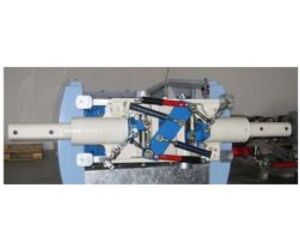
- The hub frame connects the blades to the main to the main shaft. The synchronization mechanisms and blade hinges, for flexible mounting of blades, are located in the frame.
- The hub frame can be accessed from inside the nacelle to carry out any necessary maintenance and adjustments.
- By means of a flanged connection the hub frame is mounted to the low speed shaft of the gear box.
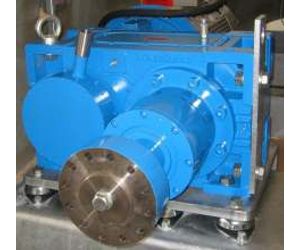
The gearbox with a ratio of 1:20 increases rotor rotation speed to match the appropriate optimal operation of the generator. Significantly oversized, the nominal power is 125kW, it is also the supporting base for the rotor and the generator. The low speed shaft bearings are suitably reinforced to directly support the rotor. These bearings and the gearbox are lubricated in oil bath and the only maintenance required is oil change every 3 to 5 years. The generator is mounted directly on the fast speed shaft by means of a flexible coupling. The whole unit – rotor, gearbox, generator – is placed on flexible supports to avoid transmission of vibrations to the structure of the turbine. The gearbox is equipped with a brake which prevents the rotor from turning backwards. This way the turbine can be halted and secured simply by yawing 120° it out of the wind.
For maintenance operations the rotor high speed shaft can be manually blocked by means of a manually activated parking brake.
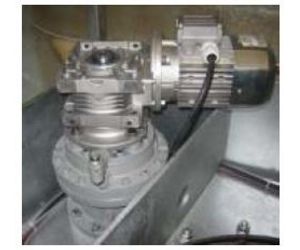
The active yaw system, consists of a ball bearing slewing ring with external gear and a combined helical/epicycloidal gearmotor that allows to turn the wind turbine in or out the direction of wind as required. In the case of grid failure, the yaw motor is directly connected to the generator. This way the turbine will autonomously and automatically yaw out of the wind.
Friction brakes are mounted on the slewing ring to avoid a constant stress to the gearmotor from the rotor.
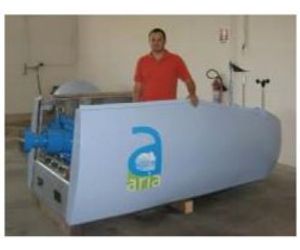
The nacelle is mounted on the tower by means of the ball bearing slewing ring. It consists of a hot dip galvanized steel structure and of a reinforced fiber glass aerodynamic cover. The size of the nacelle is such that it can be internally accessed by an operator for adjustment and maintenance purposes. In order to stand in the upright position the operator can open the upper section of the nacelle while secured by one meter high side borders. Access to blade pitch adjustment mechanisms that are installed on the hub frame is assured from inside the nacelle without dismounting the cover.
The self supporting tower consists of two to three hot dip galvanized cylindrical parts mounted to each other by means of flanged connections. The different tower heights, respectively 19, 24, 27 or 30 mt, allow the rotor to work out of the strongest turbulence. The costs and installment time are reduced thanks to the fact that the tower may be assembled on the ground and erected after the nacelle connecting cables have been installed. The tower is equipped with an access door at it base and with an internal ladder that allows safe autonomous ascent to the nacelle for maintenance purposes, even in case of adverse weather conditions.
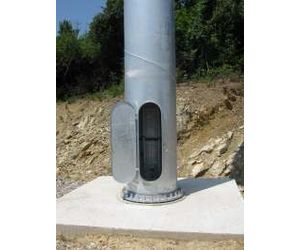
The foundation design depends on the conditions of local terrain which can be assessed by a geological survey. In case of insufficient support, a piled foundation may be necessary.
The standard foundation which is valid in almost all conditions, consists in a 6x6 mt reinforced concrete platform that is 0.5 mt thick and is laid one mt underground. At the center of the platform there is a reinforced cement 2x2 pillar that surfaces on the ground and contains a basket with 28 galvanized steel anchor-bolts. Foundation construction supply is not included in the turbine package.
The generated power, three phase and with variable voltage and frequency, cannot be fed into the grid unless it is first transformed to constant voltage and frequency.
To this end a special conversion system (patented by Aria srl) consisting of an industrial motor inverter and a combination of auxiliary motor/generator is used. The auxiliary generator is the only device that is connected to the grid. This 4-pole three phase asynchronous generator is a very sturdy and reliable component that can stand high momentary overloads such as those caused by lightening.
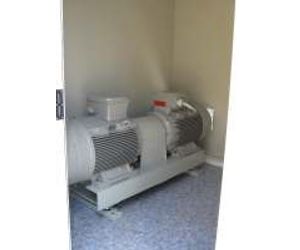
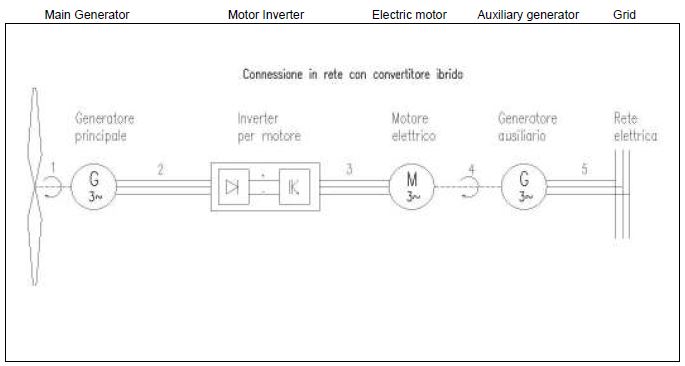
The conversion system also acts as a separator between the grid and the generator: it grants the dampening of overloads which normally derive form wind speed variation (gusts) by means of a ‘flexible’ connection between wind energy and the energy that is fed into the grid.
At the moment of auxiliary generator connection a motor soft starter is used to limit inrush currents from the grid.
The power factor of the auxiliary generator is corrected by means of compensation capacitors, granting a power factor greather than 0,90 or 0,98 at nominal power, according to total installed capacity.
Thanks to the rotating three phase generator (with no inverter connected to the electrical grid), absolutely no harmonics are generated, and therefore harmonic filters are not needed. In the same way direct currets are not generated, therefore an isolation transformer is not needed, and the generator may be directly connected to the grid.
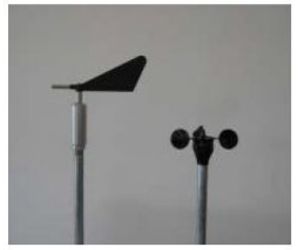
Control of the wind turbine is achieved by means of an industrial PLC equipped with a local display and with a remote control diagnostic system through a GSM modem. All of the operational parameters are constantly assessed by means of dedicated sensors:
Speed and wind direction, rotor rotation speed, direction of nacelle and possible cable winding, irregular vibrations or oscillations, power supplied, temperature of control and conversion system.
The entire system is ‘fail-safe’ which means that in case of control system failure, the turbine automatically goes into the secure mode (rotor halted or slowly rotating). The control system electric panel contains all of the necessary interface devices that are necessary for grid monitoring and connection.
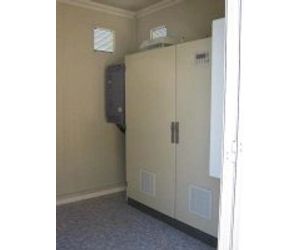
- The conversion system and the control system electric panel are placed in a cabinet that has to be located at the base of the turbine tower.
- The same cabinet can house a bidirectional electric power meter which is the grid connection device.
- The cabinet itself is not supplied with the turbine. A separate order can submitted to Aria srl.
General:
- Turbine type: HAWT
- Wind class: IIIA
- Cut-in wind speed: 3 m/s
- Nominal wind speed: 11 m/s
- Cut-out wind speed: 25 m/s
- Extreme wind speed: Ve50 = 52,5 m/s
- Generator nominal power: 55kW
- Max Power: 57kW
- Nominal voltage: 400V ±10% 3 ph 50Hz
Rotor:
- Number of blades: 2
- Diameter: 18m - 19m
- Rotational speed: variable 55 - 95 rpm
Generator:
- Generator type: asynchronous - 4 poles
- Nominal power: 55 kW
- Nominal voltage: 400 V
Power Converter:
- Converter type: combined: inverter + rotating asynchronous converter
- Conversion principle: AC-DC-AC + rotating converter
- Grid connection: asynchronous generator 55 kW
- Nominal voltage: 400 V
- Frequency: 50 Hz
Tower:
- Tower type: cylindrical pipe
- Number of sections: 2 or 3
- Hub height: 19m - 25m - 31m
- Material: hot dip galvanised steel
- Location ascent: internal
Control System:
- Remote control: Yes
- Yawning system: active
- Yawning motor: n. 1
- 1° safety system: passive blade pitch
- 2° safety system: yawning out of the wind
Weights:
- Rotor: 900 kg
- Nacelle including rotor: 2.900 kg
- Tower without nacelle: 7.700 kg (H=31m)