
- Home
- Companies
- TESVOLT GmbH
- Products
- TESVOLT - Model TS-I HV 80 - Lithium ...
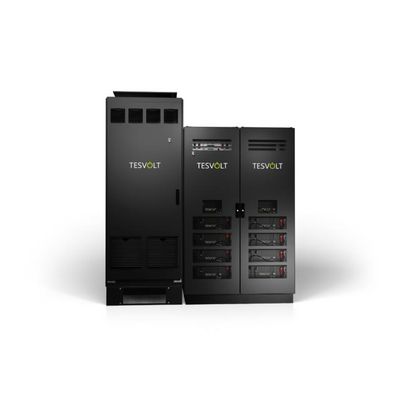
TESVOLT - Model TS-I HV 80 -Lithium Storage System - The Allstar
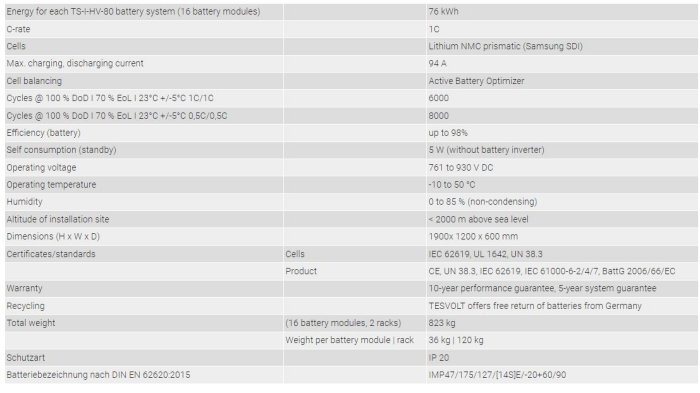
Versatile application options. Incl. integrated inverter, TESVOLT Energy Manager & myTESWORLD portal. Incl. power quality technology. Flexible configuration and expansion possible even years later. Designed for a long lifespan of 30 years or 8,000 full cycles. 1C charging speed. Utmost cell technology safety.
The new TS-I HV 80 is our first battery storage system with an integrated TESVOLT inverter and our innovative energy management system, which consists of the TESVOLT Energy Manager and myTESWORLD portal.
Back-up power, self-consumption optimisation, peak shaving, consumer and generator control, on- and off-grid use – the TESVOLT TS-I HV 80 is not only the ideal electricity storage solution for virtually every application, but also features power quality technology to improve the quality of the local utility grid for the long term. With its multi-use capability, it can simultaneously be used for self-consumption optimisation and for peak shaving.
And of course, the TS-I HV 80 also boasts all the advantages of our other products: Samsung SDI battery cells, innovative technologies such as the Active Battery Optimizer, the flexibility to upgrade, and a lifespan of up to 30 years.
Black Start-Capable
The battery inverter can be operated off-grid or supply back-up power in the event of a power outage
Power Quality
Stabilises voltage and frequency while reducing load imbalance, reactive power and harmonics in the local utility grid
Modular Principle
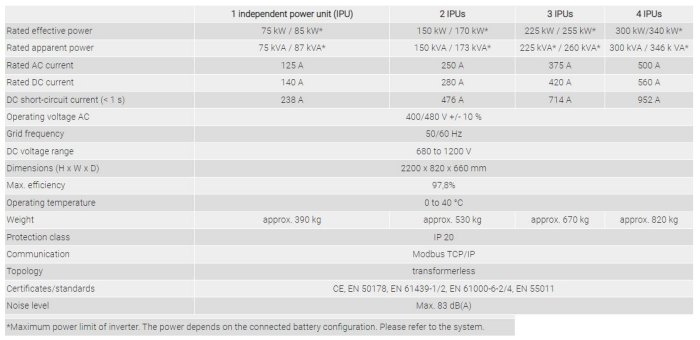
The inverter consists of up to four IPU inverter modules (of 75 kW each with two battery strings; can be upgraded at any time)
Control Rate
Response time to power requirements in the utility grid in milliseconds
Maximum Power Density
Potential for up to 340 kW with a footprint of just 0.54 m2
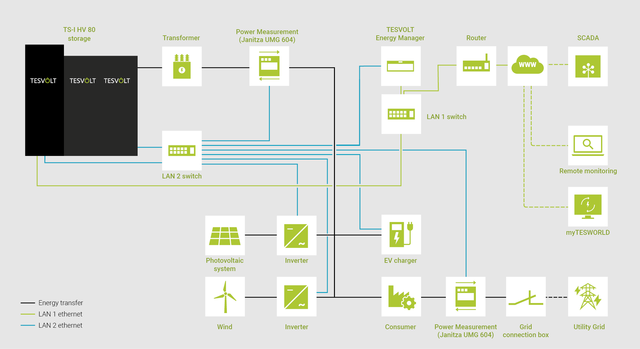
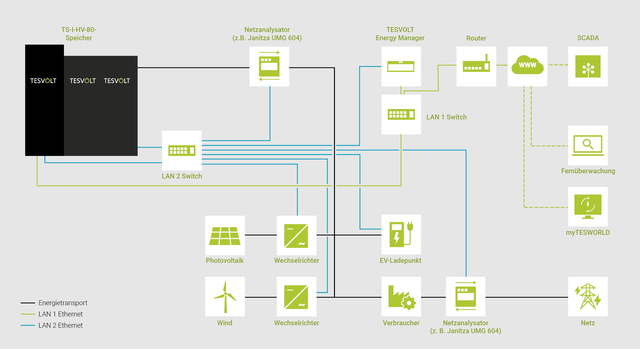
All energy flows can be recorded, controlled and monitored second-by-second with the innovative TESVOLT energy management system – consisting of the TESVOLT Energy Manager and myTESWORLD portal. By setting individual operational strategies, you can combine a wide variety of applications and thus perfectly adapt the system to the needs of trade and industry.
The TESVOLT energy management system is available both as a free Basic version and as a fee-based Pro version with valuable additional functions, such as the multi-use feature and minute-by-minute data evaluation for even greater transparency.
Sites that are far from the utility grid, such as mountain huts, have until recently needed a diesel generator or combined heat and power unit to obtain a continuous power supply. Although these technologies can be procured relatively cheaply, their maintenance and operating costs are higher.
The TS-I HV 80 can be combined with renewable energy sources such as photovoltaics or wind power to form a stand-alone system, thus providing an off-grid electricity supply that is not only greener, but also more cost-effective.
Because the TS-I HV 80 allows the battery to be used in multiple ways concurrently, two operational management strategies can be combined: self-consumption optimisation (SCO), peak shaving (physical or RLM) or Time of Use (ToU).
The storage system can be configured as needed, with the ability to define a specific storage range for each use case. This maximises the storage system’s service life, meaning that investments will pay for themselves sooner.
Power outages are a crucial consideration for many businesses. Ventilation, heating, cooling and production machines cannot be allowed to go idle, as this risks causing economic losses. Often, emergency diesel power generators are installed as a backup, but these incur high fuel and maintenance costs, as well as generating noise and emissions.
By contrast, the TS-I HV 80 provides a clean, reliable source of back-up power and helps cut operating costs by a considerable amount.
Free Basic Version
Self-Consumption Optimisation
Use more energy from renewable sources and minimise feed-in
Off-Grid
Create your own power grid independently of energy suppliers, for example by combining a photovoltaic installation and TESVOLT storage solution
Physical Peak Shaving
Shave consumption peaks and cut demand rate costs
Back-up Power
The storage system immediately takes over the power supply in the event of a power outage
Grid System Services
Remote control of active and reactive power
Zero Feed-In
Fulfils the normative guidelines (Germany) stipulating that no power can be fed into the utility grid
Generation Control
Generators such as CHPs can be actively switched on or off and regulated for greater independence from energy suppliers
Load Control
Actively switch consumers on and off depending on generation and consumption
PV-Diesel-Hybrid Optimisation
TESVOLT solutions offer the option of making the utility grid available while counterbalancing production and consumption peaks. This keeps diesel generators operating as efficiently as possible to minimise diesel costs
Fee-Based Pro Version
RLM Peak Shaving
A smart way of reducing consumption peaks at 15-minute intervals and making full use of storage systems
Time of Use
Time-dependent use of functions
Power Quality
Keep the utility grid in a constant, correct frequency range. Harmonics are counterbalanced dynamically, improving the power quality in the system
Multi-Use
Simultaneous use of two applications: Either LSK & EVO, or LSK & Time of Use, or EVO and Time of Use
Micro-Grid
Supplying a small power grid with or without connection to a public utility grid; here, the battery makes part of the grid available when only a limited grid connection is available
Charging Station Control
Smart interconnection of the charging station and central controls via the TESVOLT Energy Manager. This means charging processes can be digitally recorded and controlled
Ancillary Services
Contribute to short-term utility grid stabilisation (primary operating reserve POR, secondary operating reserve SOR, tertiary control TC)
Direct Marketer Interface
Gives access to direct marketers for the purposes of marketing electricity from renewable energy sources.
Forecast-Based Charging
Depending on the weather forecast, curtailment losses from photovoltaic installations are avoided and self-consumption is optimised
Semi-Off-Grid Operation
Consumers are fed either from the grid alone, or else up to 100% from a storage system and renewable energy installations. In-house energy sources are never connected to the public utility grid.