
Mepu - Bio Heaters
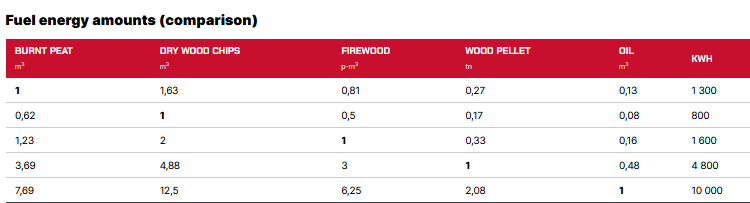
Bioenergy can replace environmentally harmful and expensive fuels, such as oil. An environmentally friendly and sustainable biomass stove brings significant savings in energy costs. The wetter the grain to be dried, the greater the savings accumulated. Bioheaters can burn wood chips, peat, pellets, and pre-cleaning waste.
Many Finnish farms already have equipment and machinery suitable for the harvesting, processing, and transportation of wood. The raw material, wood, is often sourced from the farm itself, increasing self-sufficiency. Typically, wood chipping is outsourced, often arranged for a year`s supply at a time.
Mepu bioheaters have excellent heat exchanger efficiency.
Bioheating refers to the production of thermal energy from biological sources, such as organic waste or plants. Bioheat can be produced by burning wood or pellets or by utilizing organic waste in a biogas reactor.
A Bioheater can be used for heating, domestic hot water heating, and as thermal energy for various industrial processes. Bioheat is a renewable energy source that reduces carbon dioxide emissions compared to the use of fossil fuels.
In addition to grain drying on farms, bioheat can be used for heating in greenhouses, temporary heating needs at construction sites, lumber drying in sawmills, or firewood drying. On crop farms, even sorting residues can be utilized as bioenergy.
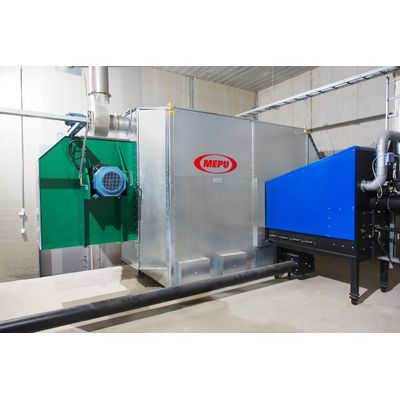
The heat exchanger efficiency of Mepu bioheater is excellent. Bio-heater can be integrated into grain drying systems, greenhouses, stables or any space requiring warm air. The orientation of the heater can be chosen when ordering.
Mepu bioheaters are very economical in terms of operating costs. Significant savings, even in the tens of thousands of euros can be achieved over the stove`s long lifespan and transitioning from oil to bioenergy is surprisingly easy.
"In the test conducted by Jyväskylä University of Applied Sciences, two nominal power classes of bio heaters were involved. The 500 kWh nominal power proved to be able to provide 650 kWh, and the 750 kWh nominal power proved to be able to provide 950 kWh. The test was conducted outdoors, measuring parameters such as the moisture percentage of wood chips, flue gas temperature, efficiency at nominal power, particle emissions, and the proportion of unburned gases. The results for clean combustion and efficiency were top-notch," says Pasi Rautiainen from Mepu Oy.
Bioheaters can be equipped with burners from various manufacturers, and their user-friendly logic control ensures system operation. Mepu Oy recommends the Ariterm Säätötuli burner, which was used to measure increased nominal power for larger heaters.
"We have selected Ariterm burners because their ceramic component is key to achieving high, clean, and efficient combustion when combined with the Mepu bioheaters," says Pasi Rautiainen.
The flue gas fan adjusts continuously with a frequency converter controlled by the combustion chamber`s negative pressure measurement.
An estimated 10-15 percent of Finnish grain farms already use bioheating.
"Bioheating is a growing trend, especially among younger generation farmers who are interested in environmental issues, carbon neutrality, and fossil-free alternatives," says Pasi Rautiainen.