

- Home
- Companies
- MVS Engineering Pvt. Ltd.
- Products
- MVS - Model StirLIN - Liquid Nitrogen ...
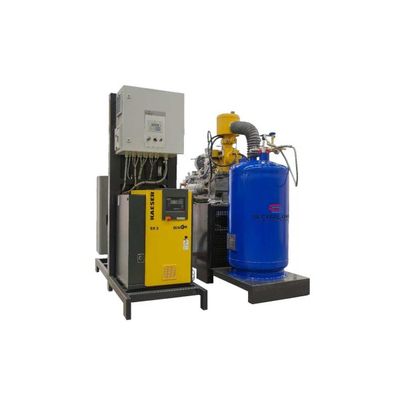
MVS - Model StirLIN -Liquid Nitrogen Liquefiers
Stirling Cryogenic’s StirLIN products consist of a wide range of liquid nitrogen liquefiers producing LN2 in volumes from 3 up to 150 liters per hour (70 to 3,600 liters per day). MVS supplied Liquid Nitrogen Generators are the preferred solution for customers looking to install a plug and play, ready to produce system. These generators occupy very little space, use electrical power for its operation and produce Liquid Nitrogen on-site. using electrical power, taking up little space.
The functionality and specifications of the StirLIN range and the advantages of StirLIN liquid nitrogen liquefaction system:
- Ease of installation
- Fully automatic operation by PLC control
- Extendible LN2 production capacity
- Adjustable liquid nitrogen pressure
- Efficient production by using the StirLIN cycle
- Easy liquid nitrogen dispensing
- Low noise level
- No Defrosting / Purging is required
- 1st drop of liquid nitrogen within 10 minutes
- Auto re-start
- Remote monitoring facility (optional)
- Built for Indian Climatic Conditions
The central element in all equipment of the Stirling Cryogenics brand is the Stirling Cycle Cryogenerator. The Stirling Cycle is remarkable because it is a closed cycle in which the Cryogenerator’s internal working gas (He) never comes into contact with the fluid to be cooled; they connect only by flow of heat through the heat-exchanger wall. This concept eliminates contamination of the customers process as well as of the Stirling Cycle working gas, resulting in long continuous operating periods and longevity.The Stirling Cycle alternately compresses and expands a fixed quantity of helium in a closed cycle. The compression takes place at room temperature to facilitate the discharge of heat caused by compression, whereas the expansion is performed at the cryogenic temperature required by the application.
The Stirling cycle is a thermodynamic closed cycle invented in 1816 by the Scottish minister Robert Stirling. It was used as an engine and was considered at the time to be capable of replacing the steam engine since their steam boilers were prone to life-threatening explosions. The counterpart of the Stirling engine, the refrigerator, was first recognized in 1832. Both machines experienced high and low points during the nineteenth century. The principle behind the machines was almost condemned to obscurity after the invention of the internal combustion engine (gas-, petrol-, and diesel motors) and compressor refrigerators with external evaporation.In 1946 Philips started optimizing the Stirling cycle to be used for cryogenic cooling. The result was the development of the world conquering Stirling Cryogenerator, marking the start of significant cryogenic activities at Philips. Though the Stirling engine itself never became a commercial success, the Stirling Cryogenerator has been selling by thousands worldwide and has been incorporated in equipment and projects used from Antarctica to the North Pole.
Your own reliable cold source
With a Stirling Cryogenerator you’ve got your own reliable and efficient cold source. Stirling Cryogenics is committed to making you fully self-supporting. No longer will you be dependent on the bulk supply of liquid gas. No longer will you waste expensive evaporated gases. Simply create a cold spot in your process, liquefy the gas required or recondense coolant gas in a closed-loop system. Stirling Cryogenics always has the right cooling solution for the job and the global service network to support you.
Extreme cold anywhere, anytime
Stirling Cryogenics developed?the Stirling Cycle?Cryogenerator almost 60 years ago and it has been the cornerstone of our cooling systems ever since. The Stirling Cryogenerator makes it possible for our systems to produce temperatures ranging from 200 K (-75°C) down to 15 K (-258°C). Businesses, industries, hospitals and research centers all over the world rely on our expertise to provide them with a reliable, on site, supply of gases and liquids for cooling purposes. A Stirling Cryogenics cooling system is an indispensable piece of equipment in those situations where constant cryogenic cooling is crucial.
Stirling Efficiency
The Stirling Cryogenerator is extremely efficient compared to other cryogenic cooling principles Carnot efficiency is 30% at 77K, resulting in a high practical over-all efficiency defined as Watts of cooling power available to the application divided by kW of electric input power. Depending the application’s temperature, the over-all efficiency of the Stirling Cryogenerator varies between 10% for LN2 applications to over 20% for LNG systems.