


- Home
- Companies
- Fanox Electronic, S.L.
- Products
- Fanox - Model SIL-D - OC&EF Directional ...
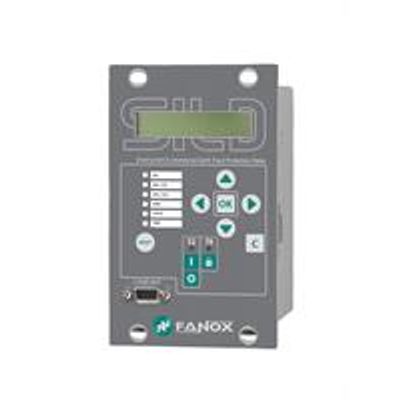
Fanox - Model SIL-D -OC&EF Directional Protection Relays
SIL-D relay is designed to protect MV systems with isolated neutral. In switchgears with isolated neutral, the earth fault calculation cannot be done as an exact value due to it is not dependent from the short circuit power. It depends on the MV system capacitor it is connecting to. For this reason, the earth fault is related with the network voltage and with the features of the lines connected to the mentioned system.
Apart from the phase and neutral instantaneous overcurrent, and protection against phase inverse time overcurrent, the relay provides directional neutral overcurrent and directional isolated neutral overcurrent as well as circuit breaker failure supervision, neutral overvoltage and trip block for switch disconnector.
A recloser is fitted. This automated control shall permit closure (up to five attempts) with the possibility of programming each reclosing time
Further functions have been included, such as the cold load pickup, or the trip circuit supervision.
Main Applications: Distribution and transformation substations. RMUs and SF6 insulated Switchgears.
SIL-D relay is an overcurrent and directional earth fault protection relay for Primary and Secondary Distribution.
- Auxiliary power supply (24-220 Vdc / 48-230 Vac).
- Protection functions: (2) 50 + 50/51 + (2) 50N/G + (2) 50N/51N/67N(1) + 52 + 50BF + 79 + 74TCS + CLP + 86 + 49T + 59N. Optionally, directional isolated neutral overcurrent(2) : 67NI_1 and 67NI_2.
It includes switch disconnector protection function by means of trip blocking. - Function 67NI. Directional neutral isolated overcurrent with two neutral directional units: 67NI_1 and 67NI_2.
This function is based on two supervisions: The analogue to the one that uses the 67N to check that the residual current is inside the defined area by the settings of directionality, operation angle and halfcone, and the second supervision of the modules of the residual voltage and current. - To perform the directional detection, the residual voltage is used as polarization magnitude and the residual current as an operating magnitude. The intervention sector in forward direction is defined in the following way: the operating angle is rotated anticlockwise from the negative residual voltage,-V0 which gives us the maximum torque direction. A cone is drawn, with the half-cone angle adjusted, over this maximum torque direction. In the same way, the intervention sector in reverse direction is defined in the following way: the operating angle is rotated anticlockwise from the positive residual voltage, V0 which gives us the maximum torque direction. A cone is drawn, with the half-cone angle adjusted, over this maximum torque direction.
When 67NI is not activated the functions works like 50/51G. - 5 attempts of reclosing with 79 protection function (Recloser). Direct signalling/control of function 52 (Circuit breaker) and function 79 (Recloser).
- Metallic box with high electromagnetic compatibility level (EMC) and wide range of operating temperature.
- 1 rear port on the back with the following options respect to communication protocols:
- One rear port RS485 with IEC60870-103 or Modbus RTU selectable by settings.
- One rear port RJ45 with IEC 61850, DNP 3.0 TCP/IP or IEC 60870-5-104 (depending on the model).
- 5 Oscillographic records, non-volatile RAM memory in order to store up to 200 events and 20 fault reports, without power supply thanks to its internal RTC (Real Time Clock).
- 50 Instantaneous phase overcurrent
- 50/51 Inverse time phase overcurrent
- 50N/G Instantaneous neutral overcurrent
- 67N Inverse time directional neutral overcurrent
- 67NI Directional neutral isolated overcurrent
- 59N Definite-time neutral overvoltage
- 52 Circuit Breaker monitoring
- 50BF Circuit Breaker opening failure
- 74TCS Trip circuit supervision
- 79 Autorecloser
- CLP Cold Load Pickup
- TB Trip block for switch disconnector
- 49T External Trip
- 86 Trip Latch
- 68 Zone selection interlocking