

- Home
- Companies
- The Ocean Cleanup
- Products
- Ocean Cleanup Technology
Ocean Cleanup Technology
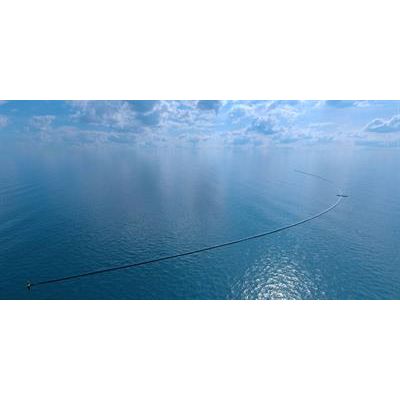
Cleaning up the Great Pacific Garbage Patch using conventional methods - vessels and nets - would take thousands of years and tens of billions of dollars to complete. Our passive systems are estimated to remove half the Great Pacific Garbage Patch in 5 years, at a fraction of the cost. Our first cleanup system is set to be deployed mid-2018. This is how it works:
-
Autonomous
Algorithms help specify the optimal deployment locations, after which the systems roam the gyres autonomously. Real-time telemetry will allow us to monitor the condition, performance and trajectory of each system.
-
Energy neutral
Our systems fully rely on the natural ocean currents and do not require an external energy source to catch and concentrate the plastic. All electronics used, such as lights and AIS, will be powered by solar energy.
-
Scalable
By gradually adding systems to the gyre, we mitigate the need for full financing upfront. This gradual scale-up also allows us to learn from the field and continuously improve the technology along the way.
The speed the plastic arrives at our moving systems is substantially lower than at a fixed structure, having a positive impact on our systems` capture efficiency. The downforce on the plastic, created by water that needs to move underneath the solid screen, will be smaller. The lower the downforce, the greater the chance particles do not get pulled under the screen.
The forces our moving system has to withstand are significantly reduced compared to that of a fixed structure, where by definition it needs to absorb all forces from the current and the wind added together. The forces on a drifting system become substantially less in comparison, regardless the weather conditions.
Our floating systems are designed to capture small plastic down to 1 cm, up to massive discarded fishing nets (ghost nets) of tens of meters in size.
Models show a full-scale cleanup system roll-out could clean up 50% of the Great Pacific Garbage Patch in 5 years.
By removing the plastic while most of it is still large, we prevent it from breaking down into dangerous microplastics.
Combining the cleanup with source reduction on land paves the road towards a plastic free ocean in 2050.
As what we aim to build has never been built before, a crucial part of our engineering process is to constantly question our design and test our assumptions wherever possible. On top of having a team of creative thinkers as well as a network of external advisors, we often receive useful input from outside sources. If you are an engineer, a researcher, a student or simply an innovative mind, your ideas could help clean the ocean.
Over the past 3 years, we moved from feasibility research, to reconnaissance missions, to extensive scale model- and prototype testing. We expect our first operational cleanup system to be deployed in the Great Pacific Garbage Patch by mid-2018.
Our idea has developed and improved substantially since the first conceptual design and the feasibility study. Since there is no previous technology like ours, we believe the best way to move forward is to test fast and often to look for the things that do not yet work as planned.
By scaling up, researching and working together with world-renowned offshore companies (such as Boskalis, SBM Offshore and Heerema) and institutes (including IMARES, Deltares and MARIN), we believe initiating the cleanup by mid-2018 is achievable.