

Surface Combustion - Roller Hearth Furnace
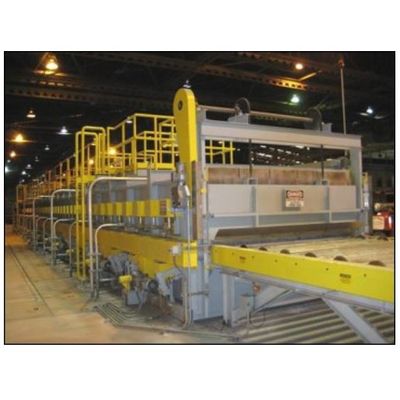
When you look to purchase anything in life, you always feel more comfortable when you go to the experts. Surface Combustion has more than 100 years of experience with thermal systems. Roller hearth furnaces are used for long product like pipes, tubes and bars and for heavier loading of product in baskets. Within the roller hearth furnace style, product is placed on the rolls in many fashions. Tube, pipe and bars incorporate laydown tables and lift and carry mechanisms. Basket loaded product is lifted onto base trays. The rollers on the charge tables and within the furnace are integrally driven in unison to move the load through the furnace. The discharge end can include slow cooling sections, quench tanks or discharge through and exit vestibule into an air environment.
Surface® Combustion’s roller hearth furnaces start with an insulated hot zone typically include a bricked floor and walls and a fiber lined roof. The heating source can be direct or indirect gas fired or electric elements. For those products requiring an internal atmosphere, only indirect gas firing and electric heating may be used. Endothermic atmosphere furnace, using RX®, gas or exothermic atmosphere furnace, using DX®, gas forms the base combination necessary for through hardening, carburizing, annealing, or normalizing. The rolls are a high-grade alloy construction. Roll drives are electrical motor driven via zone drives which are synchronized and appropriately clutched. These are continuous style furnaces, so products enter and exit through opposite ends. At the exit, an oil, polymer or water quench can be incorporated for the hardening process. For annealing or normalizing, a long atmosphere cooling chamber is used to slowly cool the load and minimize distortion. Traditional and boost diffuse carburizing–where zone separation is necessary for different process step temperatures or carbon potentials–can be performed in this type of furnace. Typical widths are 3 to 6 ft. but can be engineered to meet the required specifications for the customer’s product. This furnace style has no limitation on length. The operating range of higher temperature furnaces is typically 1400°F to 2000°F as this is a radiant/conduction style of heat transfer to the load. Lower temperature styles for tempering or stress relieving are 350°F to 1400°F and typically incorporate convection fans.
Special run in and run out clutching is necessary to minimize any gaps in loading when running long product in a roller hearth furnace. Sensors are used to allow the gaps to be closed once the incoming load has reached a certain point in the furnace. Entry and exit vestibules and separation curtains along with techniques to individually adjust the vestibule height for the specific product are employed to minimize atmosphere usage. Slow cooling zones use a combination of insulated and water-cooled walls and rolls to extract heat to minimize distortion. If quenching is required, agitation can be via pumps and nozzles or propeller agitation with full shrouding. The oil can be heated via electric bayonet style heating elements and is cooled after quenching to return the oil temperature to the setpoint.
- Ceramic Fiber or Brick insulating systems
- Maximum operating temperatures up to 2200°F
- Electric, direct gas fired (recuperative and regenerative) and radiant tube systems available
- Alloy, steel or ceramic roller hearth systems
- Controls meeting the requirements of AMS-2750 or CQI-9 can be provided as requested
- Self-emptying design
- Proprietary VF™ fan extends fan life by minimizing vibration and gives uniform atmosphere distribution
- Aging
- Annealing
- Bluing
- Bright Annealing
- Carbon Restoration
- Carbonitriding
- Carburizing
- Ferritic Nitrocarburizing (FNC)
- Hardening
- Homogenizing
- Normalizing
- Reheating
- Solutionizing
- Stress Relieving
- Temper
- Agricultural
- Automotive
- Energy
- Fasteners
- Firearms and Firearms Components
- Gears
- Government Furnace Supplier
- Hydraulic
- Oil & Gas
- Structural Shapes
- Trucking/Bus/Rail
- Aerospace Components
- Aluminum
- Bearings
- Cast Iron
- Casting
- Coil
- Forgings
- Munitions
- Pipe
- Plates
- Rod & Bar
- Rod Coil
- Slabs
- Stainless Steels
- Steel
- Titanium
- Tube
- Wire
- Atmosphere Generator
- Load/Unload Tables
- Atmosphere Cooling Systems