


- Home
- Companies
- Heatsystems GmbH & Co. KG
- Products
- Heatsystems - Screw-in Heaters for ...
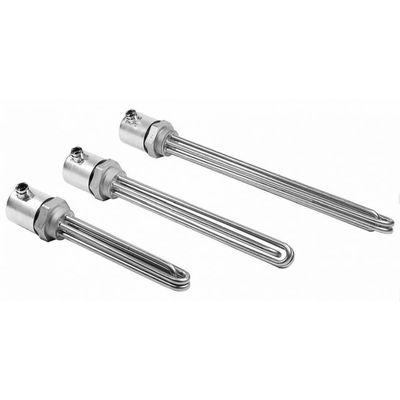
Heatsystems - Screw-in Heaters for Fluid Heating
Screw-in heaters are designed for efficiently heating both liquid and gaseous media, whether in motion or stationary. They work by directly converting electrical energy through heating rods into thermal energy, which is then disseminated across the fluid medium. The design and material selection of these heaters is crucial, tailored to specific fluid properties, pressures, and temperatures to ensure performance and durability. Special explosion-proof versions are available, indicating their use in more sensitive environments. Various heating elements can be employed within the heaters, which can be customized with control systems for precise power management. These systems can include built-in controls or be connected to external switchgear. The flexibility in design allows for optimal integration into diverse industrial applications, guaranteeing effective heating coupled with the safety and adaptability required for technological environments.
Screw-in heaters are designed for efficiently heating liquid or gaseous fluids which are flowing or stagnant. The design is based on the general conditions such as the type and properties of the respective fluid, pressure and temperature as well as the desired operating points in the process.
Screw-in heaters directly heat fluids, converting electrical energy in the heating rods to thermal energy. The thermal energy is then transferred from the heating rods to the fluid. Here, it is important that the design be matched to the general conditions, for each fluid has its specific properties.
For example, these fluids are heated by the screw-in heaters:
I. Water
- Drinking water, max. surface load depending on the water hardness 4 – 6 W/cm²
- Circulating and/or heating water, max. surface load approx. 10 W/cm²
- Softened water, observe the maximally admissible chloride content, max. surface load approx. 10 W/cm²
- Fully desalted water; here, non-ferrous metals and soldered models should not be used, max. surface load approx. 10 W/cm²
II. Oil
- Heavy oil, not pumpable in a cold condition, maximum surface load between 1 and 2 W/cm² depending on the quality
- Hydraulics oil, maximum surface load approx. 0.6 – 1.2 W/cm²
- Lubricating oil, steam turbine oil, max. surface load approx. 1 W/cm²
- Insulating oil, maximum surface load approx. 0.3 – 0.6 W/cm²Insulating oil, maximum surface load approx. 0.3 – 0.6 W/cm²
- Heat transfer oil, film temperature calculation acc. to DIN 4754 required, maximum surface load approx. 10 W/cm²depending on the flow velocity and oil
- Fuel oil, diesel, heating to max. 40 °C, max. surface load approx. 4 W/cm²
III. Gases
- Air
- Natural gas
- Flue gas
- Nitrogen
- Steam for overheating
The fluid to be heated and the application temperature mainly define the materials which can be used for the unheated and/or heated surfaces. Otherwise, corrosion may quickly result in a failure of the flow-type heater, for example.
Materials of the wetted and unheated components
- Carbon steel
- Corrosion-resistant stainless steel
- Heat-resistant stainless steel
- Titanium, Hastelloy, special materials
- Brass
Materials of the heating surface:
- Carbon steel
- Corrosion-resistant stainless steel
- Heat-resistant stainless steel
- Titanium, Hastelloy, special materials
Miscellaneous heating elements can be used for screw-in heaters. Depending on the application, they will be selected by us.
I. Heating elements
- Tubular heaters, diameter 8.5 or 16 mm
- Oval tube heaters, dimensions 16 x 6 mm
- Cartridge-type heaters, diameter 16, 18 or 25 mm
- Exchangeable heating elements, including a protective tube, diameter 25, 42 or 65 mm
Screw-in heaters can both be equipped with a built-in control system (for low power) or an external switchgear cabinet or for load switching by customer-provided switchgear and control gear. The electrical heating power can be divided into one or several heating stages. This division can individually be adjusted to match the control equipment.
I. Controllers
- Electronic ON-OFF control or PID control. (-> ON-OFF control switches off the heater if the temperature is exceeded, and switches it on again when the temperature falls below its lowest value. Thus, the temperature will always oscillate around the setpoint. The algorithm of the PID controller will optimally compensate the control fluctuations.)
- Load switching by contactors or wear-free semiconductors (thyristors). (-> contactors are wearing parts and must be replaced after approx. 100,000 make/break operations; thyristors switch quickly and without any wear but generate more heat losses than contactors.)
- Electromechanical control.
Thermostats or controller- limiter combinations built in the screw-in heaters provide a price-control with an accuracy sufficient for many applications.
II. Sensors
- Thermal protectors and limiters as capillary thermostats (as a safety design as well).
- Temperature sensors for the fluid and heating rod temperature.
- Overheating protection for the heating surface