


- Home
- Companies
- Shenton Group
- Products
- Shenton - UPS Systems
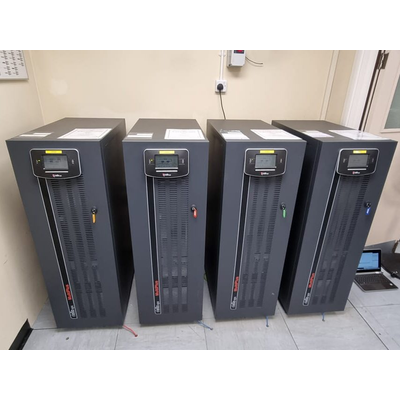
Shenton - UPS Systems
Uninterruptible power supply or UPS provides instantaneous backup power when there is a loss of power supply from the mains supply or if the voltage level drops. This ensures computers or equipment can be shut down safely, or switched over to power supplied by a generator. The design and size of a UPS determines how long the power supply will last.
Shenton Group supply UPS systems offering complete turnkey solutions.
Shenton Group is the distributor for most major brands of UPS, offering both modular and standard systems from 400VA up to 6.4MVA. We look at the bigger picture, we review your power requirements and will recommend the best solution for your needs.
Our skilled engineers will work with you and fully integrate the solution into your facility as a UPS is often just part of a wider power resilience project. To ensure the equipment's longevity, we also provide ongoing technical support and maintenance services to ensure your UPS is in full working order and is reliable when you need it most.
Online Double Conversion
Online double conversion is the most common UPS mode of operation used for protecting large data centres by providing the highest level of power quality to the load always. Online systems also provide frequency regulation, essential for use with backup generator systems to protect from variations common at generator start up.
An online UPS delivers continuous, high-quality AC power to equipment with no break when transferring to battery, protecting equipment from virtually all power disturbances due to blackouts, brownouts, sags, surges or noise interference. A true online, double-conversion UPS provides 100% power conditioning, zero transfer time to battery, no change in output voltage and better transient suppression than line-interactive units.
Line Interactive
Line-interactive UPS systems provide both power conditioning and battery backup. This technology is particularly effective in areas where outages are rare, but power fluctuations are common. Line-interactive UPS systems support a wide range of input voltage fluctuations before switching to battery backup.
Line-interactive UPS technology provides power conditioning with a 4-6 millisecond break in power when transferring to battery back-up and protects against the most common power problems experienced in a network. Here the UPS also monitors the voltage level and balances under and over voltages. This technology provides a good choice between reasonable protection and moderate operating costs.
Standby/ Offline
Offline UPS, also called standby UPS or battery backup, is a cost-effective choice. Better offline UPS systems switch to battery fast enough to prevent power anomalies and ride out short outages. An offline UPS protects against most spikes but doesn’t maintain perfect power during minor sags and surges.
It will protect most power spikes by clamping down on excess voltage and help ride out more than 90% of all outages. When an input power failure happens, the built-in battery and the inverter, which converts the battery’s DC power to AC, are activated and connected to the output by the transfer switch. There is generally about a 6-8 millisecond break in power when transferring to battery back-up.
Generators and UPS (Uninterruptible Power Supply) systems are both critical components of power management in various applications, including residential, commercial, and industrial settings. They serve different purposes but often complement each other to ensure reliable and uninterrupted power supply.
A UPS is a type of device that powers equipment, nearly instantaneously, in the event of grid power failure, protecting the equipment from damage. UPS systems vary significantly in their design and functionality, affecting the amount of time they can power equipment, their ability to improve power quality, and their cost.
A generator is an independent power solution installed when clients need to protect themselves from prolonged power outages. A generator will provide cover for outages that last seconds, minutes, hours, days or weeks.
In many critical applications, both generators and UPS systems are used together to provide comprehensive power protection. The UPS handles the initial power outage while the generator starts up, ensuring a smooth transition to generator power once it’s operational. This combination offers the highest level of power reliability and uptime.