


- Home
- Companies
- GEONICA, S.A.
- Products
- Geonica - Model LI-200 - Silicon ...
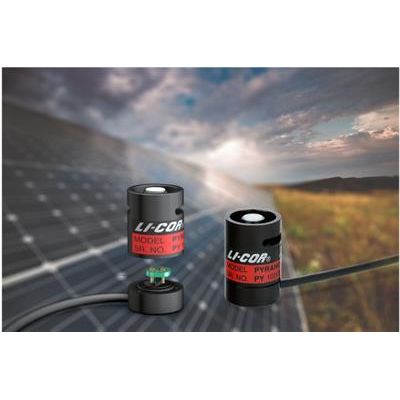
Geonica - Model LI-200 -Silicon Pyranometer
The LI-200R Pyranometer is meant to be used outdoors under unob-structed natural daylight conditions. It measures global solar radia-tion—the combination of direct and diffuse solar radiation —in the 400 to 1100 nm range. Measurement units are in watts per square meter (W rrr2).
Ideal for agricultural, meteorological, solar energy, and environmental research, the LI-200R is available with a variety of cable lengths and output signals for compatibility with most data loggers.
The LI-200R Pyranometer is meant to be used outdoors under unob-structed natural daylight conditions. It measures global solar radia-tion—the combination of direct and diffuse solar radiation —in the 400 to 1100 nm range. Measurement units are in watts per square meter (W m"2).
Ideal for agricultural, meteorological, solar energy, and environmental research, the LI-200R is available with a variety of cable lengths and output signals for compatibility with most data loggers.
Why choose the LI-200R?
- Weather resistant and durable in long-term outdoor deployments
- Measures global solar radiation under unobstructed natural daylight conditions
- Uniform sensitivity up to 82° incident angle
- Detachable sensor simplifies installation and removal, making it ideal for platforms with complex cabling
How does it work?
The LI-200R measures global solar radiation with an unfil-tered silicon photodiode. Its measurements correspond closely to first-class thermopiles when used outdoors under unobstructed natural daylight conditions.
The crown of the sensor rapidly sheds water, and also physically blocks light from outside the hemisphere of sensitivity, providing a precise cosine response.
LI-200R Specifications
- Absolute Calibration: Calibrated against an Eppley Precision Spectral Pyranometer (PSP) under natural daylight conditions. Calibration uncertainty under these conditions is estimated as
- ± 3% typical, within± 60° angle of incidence.*
- Wavelength Range: 400 to 1100 nm.
- Measurement Units: watts per square meter (W m-2)
- Sensitivity: Typically 75 uA per 1,000 W nv2
- Linearity: Maximum deviation of 1% up to 3,000 W m2
- Response Time: Less than 1 |is (2 m cable terminated into a 147 Ohm load)
- Temperature Dependence: ± 0.15%per °C maximum
- Cosine Correction: Cosine cor-rected up to 82° angle of incidence
- Azimuth: < ± 1% error over 360°at 45° elevation
- Tilt: No error induced from orientation
- Operating Temperature Range:-40 °C to 65 °C
- Relative Humidity Range: 0% to 95% RH, Non-Condensing
- Detector: High stability silicon photovoltaic detector (blue enhanced)
- Sensor Housing: Weatherproof anodized aluminum body with acrylic diffuser and stainless steel hardware; O-ring seal on the sensor base
- Size: 2.36 cm diameter x 3.63 cm (0.93" x 1.43")
- Weight: 24 g head; 60 g base and cable (2 m) with screws
- Cable Length: 2 m, 5 m, 15 m, 50 m (6.5`,16.4`, 49.21,164`)