

- Home
- Companies
- TYFOROP Chemie GmbH
- Products
- Solarclin - Cleaning Liquid for Solar ...
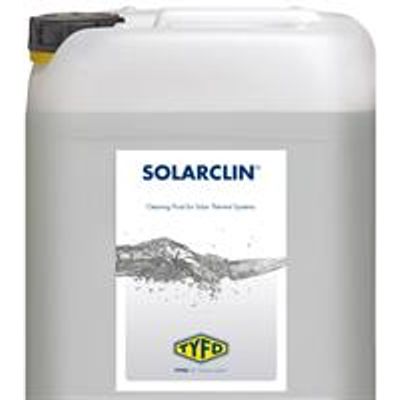
Solarclin - Cleaning Liquid for Solar Thermal Systems
SOLARCLIN is a neutral, colourless, slightly hygroscopic, free-flowing, high boiling liquid with a very faint scent. It can be mixed with water and common organic solvents in any concentration desired. Due to its structure, it performs very well as a solvent for impurities that have developed as a result of the heat transfer fluid being exposed to excess thermal stress in evacuated tube collectors.
- Solar thermal systems
- t.b.a
TYFOCOR LS is a liquid based on an aqueous solution of physio-logically unobjectionable propylene glycol with a faint odour. The fluid was developed especially for use in solar thermal systems with high thermal loads (vacuum tube collectors).The corrosion inhibitors contained in the product reliably protect the metals normally used in solar technology even in mixed installations against corrosion, ageing and deposits over long periods of time. It keeps the surfaces of heat exchangers clean, and thus ensures consist-ently high thermal efficiency of the solar thermal system.
In order to maintain its specific properties, TYFOCOR®LS® must nei-ther be mixed with other heat transfer fluids, nor it must be diluted with water! If any leakages occur, the system must be topped up with TYFOCOR®LS® only!
TYFOCOR LS can be used in solar thermal systems with high stagnation temperatures provided it is ensured that the solar fluid will completely drain out of the collectors into the membrane expansion vessel in case of stagnation. TYFOCOR®LS® must not be exposed to sustained temperatures higher than 170 °C. Temperatures higher than 200 °C lead to slow thermal decomposition of propylene glycol, which is indicated by darkening of the heat transfer fluid. The lifetime of the fluid thus may be strongly reduced, and the reliability of the system may be endangered
The following table demonstrates the anticorrosion effect of TYFOCOR®LS® after two weeks of testing at 88 °C under permanent aeration. Corrosion test according to ASTM D 1384 (American Society for Testing and Materials)