


- Home
- Companies
- Synhelion SA
- Products
- Synhelion - Sun-to-Liquid Technology
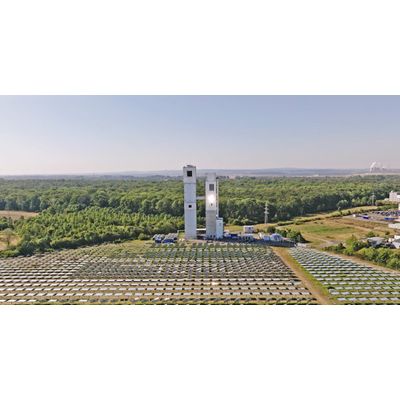
Synhelion - Sun-to-Liquid Technology
Synhelion uses solar heat to convert CO2 into synthetic fuels – so-called solar fuels. Solar radiation is reflected by the mirror field, concentrated onto the receiver, and converted into high-temperature process heat. The generated heat is fed to the thermochemical reactor that produces syngas, a mixture of H2 and CO. The syngas is then processed by standard gas-to-liquids technology into fuels, such as gasoline, diesel, or jet fuel. Excess heat is saved in the thermal energy storage (TES) to enable continuous 24/7 operation. Our solar fuels are compatible with the existing global fuel infrastructure and reduce net carbon emissions by up to 100 percent.
Our solutions combine state-of-the-art solar tower systems with proprietary high-temperature thermochemical processes. The Synhelion technology unites four key innovations:
- The mirrors (heliostats) reflect the sun’s radiation and precisely concentrate it onto the solar receiver.
- The solar receiver delivers clean solar process heat at unprecedented temperatures beyond 1’500°C.
- The thermochemical reactor utilizes the solar heat to produce syngas.
- The thermal energy storage enables continuous 24/7 operation.
REFLECTING THE RADIATION OF THE SUN.
HeliostatThe heliostats were specially developed for and coupled to our unique technology. They follow the sun, reflect its radiation, and concentrate it directly onto our solar receiver. Our precise control technology focuses the heliostats to minimize optical losses and optimize the use of space and material resources. This allows us to achieve the lowest cost per reflector area. The heliostats are slightly curved to increase solar concentration and are specially designed to couple with our solar receiver.
GENERATING SOLAR PROCESS HEAT.
Solar ReceiverOur solar receiver is inspired by nature. We use the greenhouse gas effect to reach ultra-high temperatures. The cavity is filled with a greenhouse gas flowing from the aperture toward the back of the cavity. Typical gases employed are water vapor or mixtures of water and CO2. Solar radiation enters the cavity through a window and passes with minimal absorption through the gas. The black surface of the cavity absorbs the heat, thermalizes, and reradiates it back into the cavity. The greenhouse gas absorbs the thermal radiation and is heated up, acting as heat transfer fluid (HTF). Our solar receiver can generate with unprecedented efficiency solar process heat of more than 1’500°C.
The solar heat from our solar receiver technology is applicable to various industries using high-temperature process heat.
MAKING THE MAGIC HAPPEN.
ReactorWe develop two thermochemical processes and associated reactors to produce syngas. Additionally, we also develop reactors for the production of pure hydrogen.
How it works:
The reactor consists of multiple tube bundles. Each reactor tube is filled with a reactive material that enables the production of syngas. The heat transfer fluid flows through the reactor and provides the thermal energy for the chemical reactions inside the reactor tubes.
In the case of Solar Upgrading, a mixture of methane, water, and CO2 is converted into syngas at 800 to 1’300°C.
To produce carbon-neutral fuels, a mixture of water and CO2 is converted via a two-step thermochemical cycle into syngas at temperatures up to 1’500°C.
TURNING NIGHT INTO DAY.
Thermal Energy StorageOur thermal energy storage (TES) stores excess heat collected by the solar receiver during sunny hours. The hot heat transfer fluid (HTF) from the receiver streams through the TES from the top to the bottom and transfers its thermal energy to the solid storage material.
During the night or cloudy periods, the HTF flows through the TES in the opposite direction to recover the previously stored thermal energy. The hot HTF from the storage drives the thermochemical processes in the reactor, ensuring continuous operation – even in the absence of solar radiation.
Our TES technology is applicable to various industries using high-temperature process heat.
Solar Upgrading
State-of-the-art industrial reforming technology is paired with key innovations of Synhelion to enable the energy-efficient production of solar fuels. Solar heat is used to convert a mixture of methane, CO2, and water into syngas, which is then processed into any type of fuel. The solar receiver delivers the required process heat of 800 to 1’200°C to trigger this chemical reaction.
Redox splitting
The thermochemical splitting of CO2 and water in a two-step redox reaction yields carbon-neutral fuels. The thermochemical reaction to turn CO2 and water into syngas takes place at 1’500°C. This ultra-clean solar fuel closes the carbon cycle. It uses the same amount of CO2 for fuel production as is released during fuel combustion.