


- Home
- Companies
- Anhui Argosun Electronic New Materials ...
- Products
- ARGOSUN - Deuterium Gas (D2)
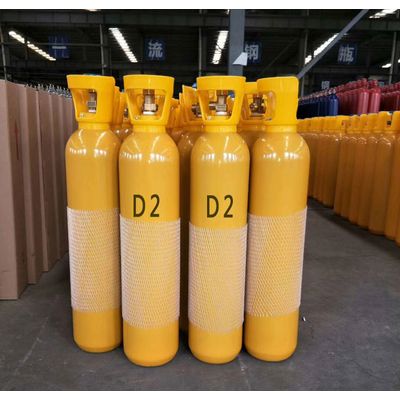
ARGOSUN - Deuterium Gas (D2)
Deuterium gas has a wide range of applications, not only in nuclear energy, controllable nuclear fusion reactions, lasers, light bulbs, experimental research, semiconductor material toughening, nuclear medicine and agriculture, but also in military applications, such as manufacturing hydrogen bombs, neutron bombs, and DF laser weapons.
Deuterium gas (D ²) It is a radioactive hydrogen isotope with the following characteristics:
- Chemical properties: Deuterium is a stable isotope of hydrogen with an atomic mass of 2. It has the same nuclear charge as ordinary hydrogen (H ₁), but different proton numbers. Deuterium exhibits similar characteristics to ordinary hydrogen in chemical reactions and can generate completely corresponding compounds.
- Physical properties: Deuterium gas is a colorless and odorless combustible gas. Its boiling point at room temperature is -249.5 ℃, and at 20.4K, the proportion of deuterium in the equilibrium mixture can reach 97.8%.
- Application: Deuterium gas has applications in industries such as semiconductor and solar cell, especially as a hydrogen source in silicon sintering or annealing processes, to replace ordinary hydrogen. In addition, deuterium gas is also used as a new fuel product with characteristics such as high density, low volatility, and high thermal combustion efficiency, suitable for industrial production, transportation, and other fields. twelve.
Basic Introduction
Chemical properties: Hydrogen is known to have three isotopes. Their (atomic) mass numbers are 1, 2, and 3, respectively called protium, deuterium (stable isotope), and tritium (unstable isotope).
Deuterium possesses all the reaction characteristics of ordinary hydrogen and generates completely corresponding compounds. The higher mass and lower zero energy (energy at absolute zero) of deuterium result in very different reaction rates and equilibrium points in the same reaction. Generally speaking, compared to ordinary hydrogen, deuterium has a slower reaction rate and a more incomplete reaction.
Physical property
- Name: Deuterium
- English name: deuterium gas
- Chemical formula: D2
- CAS registration number: 7782-39-0
- Relative molecular weight: 4.032
- Melting point: 18.73K, -254.42 ℃, -425.96oF
- Boiling point: 23.65K at 101.325 kPa (1atm), -249.5 ℃, -417.1 ℉
- Critical temperature: 38.35K, -234.8 ℃, -390.64oF
- Critical pressure: 1.66MPa, 16.64bar, 16.42atm, 241.34psia
- Critical volume: 60.26cm3/mol
- Critical density: 0.0669g/cm3
- Critical compression coefficient: 0.314
- Eccentricity factor: -0.140
- Liquid etching density: 0.15g/cm3 at -246 ℃
- Liquid thermal expansion coefficient: 0.02073 1/℃ at -246 ℃
- Surface tension at -254 ℃: 4.24 × 10⁻³ N/m, 4.24 dyn/cm
- Gas density: 0.167kg/m3, 0.0104 lb/ft3 at 101.325 kPa (atm) and 70 ℉ (21.1 ℃)
- Gas relative density: 101.325 kPa (1atm) and 0.139 at 70 ℉ (air=1)
- Heat of vaporization, boiling point: 292.66kJ/kg, 125.84 BTU/1b
- Melting heat, at melting point: 49.36kJ/kg, 21.22 BTU/1b
- Gas constant pressure specific heat capacity cp, at 25 ℃: 7.24kJ/(kg · k), 1.73 BTU/(1b · R)
- Gas specific heat capacity at constant volume cp, at 25 ℃: 5:178kJ/(kg · k), 1.238 BTU/(1b · R)
- Gas specific heat capacity ratio cp/cv: 1.398
- Liquid specific heat capacity, at -253 ℃: 5.318 kJ/(kg · k), 1.271 BTU/(1b · R)
- Solid specific heat capacity, at -255 ℃: 1.764 kJ/(kg · k), 0.422 BTU/(1b · R)
- Gas molar entropy, at 25 ℃: 144.86 J/(mol · k)
- Gas molar generation entropy, at 25 ℃: 0 J/(mol · k)
- Gas molar enthalpy of formation, at 25 ℃: 0 KJ/mol
- Gas molar Gibbs generation energy, at 25 ℃: 0 KJ/mol
- Solubility parameter: 6.264 (J/cm3) 0.5
- Molar volume of liquid: 3425.112cm3/mol
- Chemical property
- Solubility in water: 13.16 at 25 ℃ × 10-6 (w)
- Henry’s Law constant in water at 25 ℃: 6948.9Mpa/x, 68580.5atm/x
- Gas viscosity at 25 ℃: 125.9 × 10⁻⁷Pa · s, 125.9 μ P
- Liquid viscosity, at -250 ℃: 0.031 mPa · s, 0.031 cp
- Gas thermal conductivity at 25 ℃: 0.13806W/(m · K)
- Liquid thermal conductivity at -250 ℃: 0.1322W/(m · K)
- Explosion low limit content in air: 5%( φ)
- Explosion limit in air: 75%( φ)
- Autoignition point: 400 ℃, 752 ℉
- Combustion heat at 25 ℃ (77 ℉) in gaseous state: 61073.9kJ/kg, 26261.8BTU/1b