

- Home
- Companies
- Conifer Systems
- Products
- GCES - Thermal Oxidizers - Afterburners ...
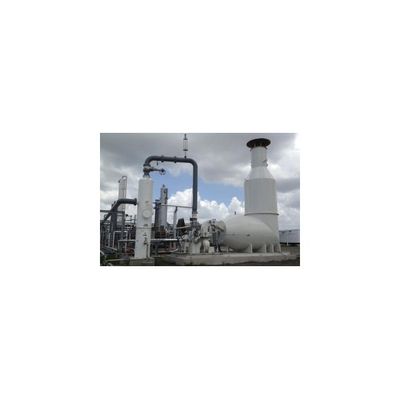
GCES - Thermal Oxidizers - Afterburners - Direct Fired Thermal Oxidizers
What Is a Direct Fired Thermal Oxidizer, and How Does It Work? A Direct Fired Thermal Oxidizer (DFTO), also known as an Afterburner, or Direct Flame Thermal Oxidizer, destroys Volatile Organic Compounds (VOCs) and Hazardous Air Pollutants (HAPs), that are created through chemical processes found in industrial exhaust streams. The DFTO destroys these emissions through the process of combustion. The chemical process of thermal oxidation is quite simple; the exhaust stream temperature is raised to between 1,250 to 1,800°F, a temperature at which the chemical bonds that hold the molecules together, are broken.
The VOCs in the process exhaust stream are converted to various combinations of carbon dioxide (CO2), water (H2O), and thermal energy by the high temperature of the combustion chamber. The Direct Fired Thermal Oxidizer, which is the most widely used abatement technology for industrial processes that produce exhaust streams with high levels of pollutants, can achieve over 99% hydrocarbon destruction rate (DRE).
The combustion chamber serves three purposes within the system:
- Purpose #1 is to initiate the ignition of the process.
- Purpose #2 is to introduce combustion air into the combustor for adequate and proper combustion.
- Purpose #3 is to retain the process stream at the operating temperature for the required elevated temperature in order to achieve the desired destruction efficiency – this is typically called the residence time.
DFTOs are best suited for exhaust streams with very high concentrations of VOCs, HAPs, odors, or smoke, which are commonly found in food and beverage processing foundries, pulp and paper manufacturing, metal treatment, etc…
- Direct Fired Thermal Oxidizers are widely considered to be a more cost sensitive option, compared to other chemical abatement systems,
- Solid, in-house construction, for extended use
- No flame visibility
- Quicker start-up
- Typically, one of the most affordable option for pollution control equipment
- DTFOs can also be more fuel efficient, when combined with heat exchangers, and downstream boilers.
- Long service life
- Minimal heat emitted
- Minimal noise pollution
- Smokeless combustion
- Custom designs, ready to use, that allow room for expansion, and system flexibility.
- Multiple safety shut-offs and features
- User friendly
- Our In-House produced control panels set us apart!
- UL Rated
- Remote access for monitoring and controls
- Remote service support
- Adjustable stack heights
- Reactor has ceramic lining, which reduces cracks and spallings, allowing for a longer product life
- Easy installation
- A digital controller, allowing proper maintained temperature control
- Weatherproof, high-density steel enclosure, allowing the processing of highly concentrated exhaust streams
- Modulating burner
- Correctly sized reactor chambers, which provide destruction efficiencies of up 99%
- Gas trains are all designed to meet international certifications such as CSA, ATEX, KOSHA, TSSA, EN, etc.
- Low NOx Burners
- Custom engineered turnkey systems
- Continuous emissions monitoring
- High temperature acid gas scrubbers
- The use of alloy construction, for corrosive gas environments
- Waste heat recovery – Custom modules
- Packages with scrubbers – Wet, Dry, and Ammonia
- quencher
- Continuous Virtual access & controls
- Chemical filling
- Chemical processing
- Tank farms
- Refinery processing
- Natural gas processing
- Oil and gas
- Ethanol
- Soil Remediation
- Founded: 2004
- Small Business Equipment in over a dozen countries, worldwide
- All engineering, design, and manufacturing is done in-house at our Texas facility
- Over 30 Industries serve