

H2ecO - Micro-Hydro & Wind Power
H2ecO`s primary interest in Hydro projects is in projects which we can develop in partnership with a landowner. We are strongly committed to long term partnerships with land-owners who are looking to revenue from renewable sources; we do not, typically, develop micro-hydro generation systems on a one-off turn-key basis.H2 ecO will consider a wide range of project sizes, though our interest is mainly in projects generating between 10 and 20 Kw of power. A surprisingly small stream with a summer flow down to half a meter - (2 feet) wide and down to 30cm - (1 foot) deep with a fall of at least 50 meters (150 feet) will generate a viable project.
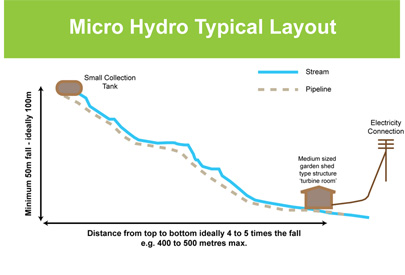
The core elements of one of our projects will include a filter grid at the top of the stream which collects part of the stream water and carries it to a holding tank also at the top of the stream. In most cases this holding tank can be buried and therefore invisible.
The tank is then connected by a shallow underground pipe to the "turbine room". This isn`t as industrial as it sounds and can be thought of as a medium to large garden shed. The shed contains the turbine and electrical equipment to convert the electricity into a form that can be fed into the mains supply. Once the water has been through the turbine, it falls back into the stream, leaving the stream completely unchanged from that point. The electricity is fed directly into the mains supply via an existing electrical connection. To avoid electricity losses, the connection should be within 100 meters of the shed. The turbines are relatively quiet in operation anyway but when contained in the soundproofed shed, they are effectively silent.
Financial returns:
These are not possible to estimate accurately until a site survey has been carried out but a system like the one above with a fall of 100m and a stable year round water supply could generate up to £4,000 - £5,000 per annum for the landowner. This could be substantially higher depending on water flow and fall.It can also be lower, but the likely returns will be thoroughly discussed with you before any formal agreement is reached.