

Taikisha USA Inc.
- Home
- Companies
- Taikisha USA Inc.
- Products
- Taikisha - Turn-key Industrial Ovens
Taikisha - Turn-key Industrial Ovens
Taikisha USA offers design, build, install, and start-up services for custom industrial oven systems. We have built industrial ovens of the following types: drying ovens, batch ovens, cure ovens, paint ovens, and more.
Most popular related searches
industrial oven
air to air heat exchanger
heat exchanger
air heat exchanger
batch oven
burner firing
radiant heating
burner
burner fan
direct fired system
Taikisha USA has designed and built industrial ovens for major Fortune 500 manufacturers, including:
- Automotive OEMs:
- Honda, Nissan, Toyota, Kia, Subaru, Mazda, etc.
- Automotive Tier-1 Parts Suppliers:
- Heartland, Chiyoda, Eakas, Kosei, TOA, etc.
- Aerospace:
- Boeing
- Heavy Trucking / Semi trucks:
- Hino Motors, several US-based Semi truck manufacturers, etc.
- Motorcycle:
- Harley Davidson
- ATV/UTV/4x4/SxS - recreational vehicles:
- Honda, Polaris, Suzuki, Kawasaki, etc.
Taikisha USA`s long oven design (non-batch oven) consists of three main parts.
- The oven is typically split up into two or more sections. The first section is the heat up zone. Taikisha USA offers three different types of heat up for an oven:
- Infrared (IR) lamps, no forced air
- Convection flow heated with forced hot air
- Radiant heating, no forced air
- The next section of the oven is the hold zone, where the actual paint cure takes place. The hold zone for metal parts is typically heated via convection / forced hot air style. For plastic parts, a lower air temp is used as to not melt or soften the plastic part itself. The hold zone for curing most paints is 18-20 minutes at the cure temperature. Each paint supplier will dictate the "cure window" or the time/temp window for proper paint cure. Burner sizing is not so critical here because there should be no heat load, simply maintaining temperature.
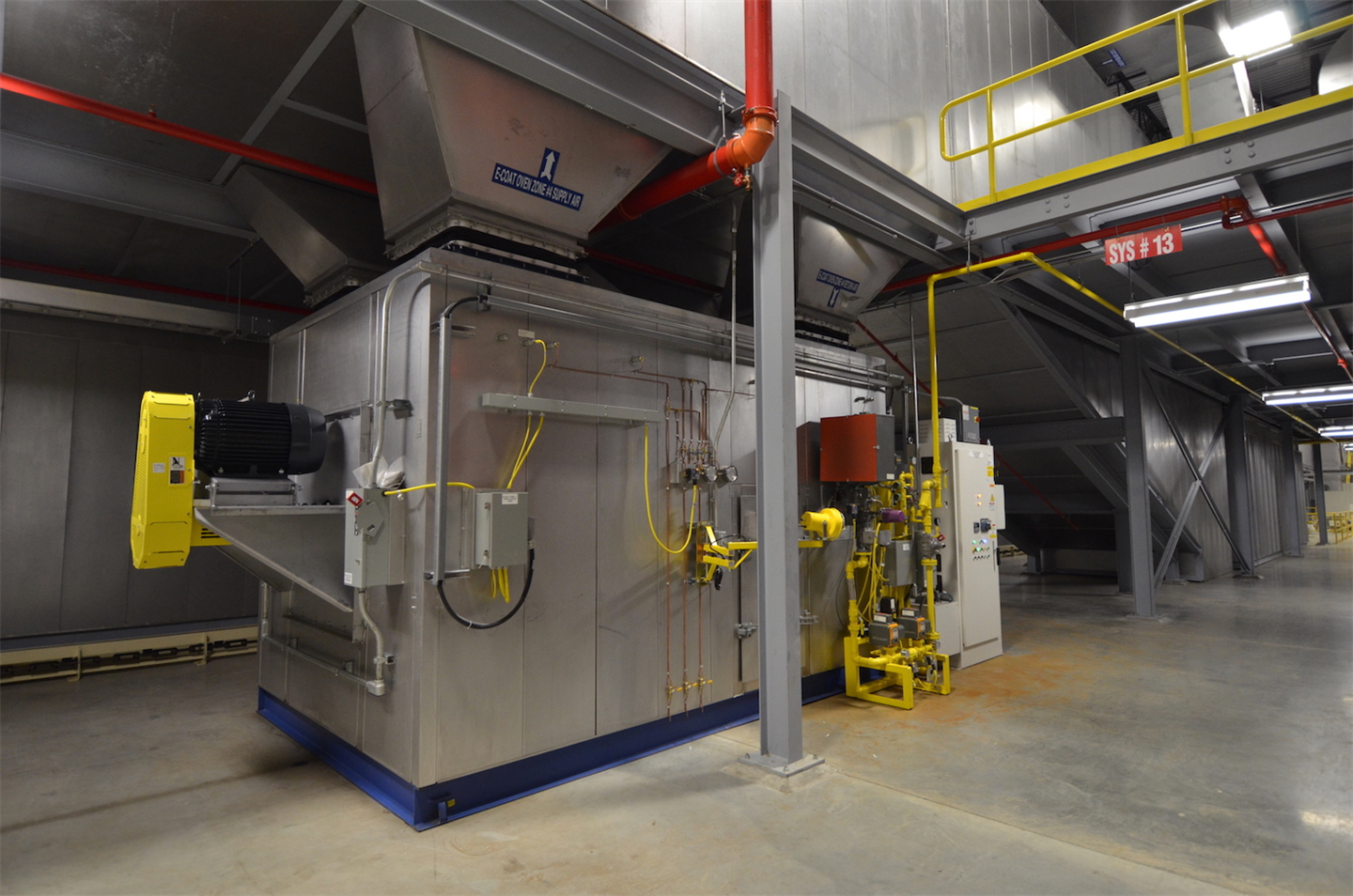
- The third key part of an industrial oven is the heating system: heater box, burner, ductwork, fan, and heat exchanger (HEX) - if applicable. Even within convection style ovens, there are several types of heating systems: direct-fired, indirect-fired, and semi-indirect fired.
- Direct-fired ovens do not use a heat exchanger, the hot, burner-fired air is sent directly into the oven, along with the products of combustion. For white paints, this can cause a yellowing of the paint color, so direct-fired ovens are only used for under layer coats such as Electro-coat (electro-deposition), sealer, and primer. It can also be used on Electrophoretic or black E-Coat paints for truck frames or service parts. Direct-fired ovens are not used for top coats, base coat, or clear coat.
- Indirect-fired ovens utilize an air-to-air heat exchanger (HEX), using the hot combusted air to heat fresh, clean air. The "clean" hot air is then sent into the oven itself. This way, the hot air in the oven is free from products of combustion and the white-painted parts will not yellow. Indirect-fired ovens are considered safer because there isn`t a risk that gas will leak into the oven, and recirculated VOC-laden air from the oven will not reach the open flame of the burner. Typically, indirect-fired ovens do not require explosion relief.
- Semi-indirect ovens (or semi-direct ovens) are less common, but are sometimes utilized for safety. In the semi-indirect oven, the burner is offset in its own firing chamber, with a combustion blower providing fresh air. There is no heat exchanger, the combustion blower pushes the hot, fired air into the oven`s recirculation ductwork, and it`s carried down into the oven. In this design, products of combustion still reach the oven, since there is no heat exchanger, but the solvents or VOCs that flash off in the oven will never reach the burner, as they would in a direct-fired oven.
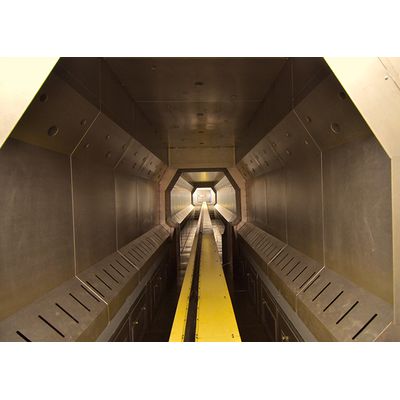
- The last critical element not touched on above is the conveyor which moves the vehicles or parts through the oven. Typically a chain-type conveyor is used here due to the heat load. New Taikisha USA oven designs locate the conveyor drive motor outside the oven, and only the chain portion inside. The chain and carrier may also be shrouded or covered by a metal sheathe with only the jig and parts sticking out. This reduces heat load on the oven, reduces dirt and grease inside the oven, and extends the lift of the conveyor itself.