


- Home
- Companies
- Inproheat Industries Ltd.
- Products
- Inproheat - Compact Welded Heat ...
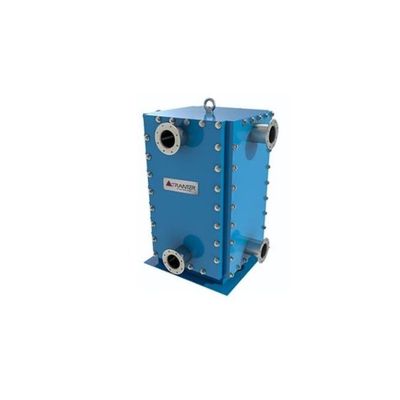
Inproheat - Compact Welded Heat Exchanger
Inproheat Industries offers Compact Welded heat exchangers from Tranter and Nexson. These heat exchangers are defined by an assembly of plates that are usually washboard-patterned-embossed or herringbone with almost all of the design material being involved in the heat transfer process. Every other plate is turned 180°, which causes the ridges of the adjacent plates to intersect with one another – ultimately forming a lattice of contact points. When these points are subsequently brazed together, the unit functions as a compact and pressure-resistant heat exchanger.
Tranter’s Maxchanger Heat Exchanger is a popular model within this product line.
New for 2020 are the Tranter NovusBloc™ in Canada for British Columbia, Alberta, Saskatchewan, and Manitoba and the Nexson Green Block for Ontario.
Compact Design
The compact design of these heat exchangers offer a considerable reduction in size and weight as compared to traditional heat exchangers. The design lends itself well to applications in compact spaces.
High Efficiency
The smaller design encourages a compact engineered system and offers maximum pressure resistance along with a high heat transfer rate – making it ideal for high temperature applications.
Material Selection
Based on the application, a range of choices relating to product materials are available. Plates can be designed using stainless steel, titanium, or other alloys while shells are available in carbon steel, titanium, stainless steel, and other alloys.
Configuration
Many customization options are available, including the number of plates, passes, and nozzle configurations.
Compact welded heat exchangers are commonly used in processes and applications involving liquids, gases, and steam such as liquid-to-liquid cooling, liquid to steam cooling, gas-to-liquid, gas-to-gas, and two-phase mixtures.
Specific applications that are ideal for these heat exchangers include:
- General purpose oil, water, and gas cooling.
- Cooling mechanical and electrical equipment.
- Compressors, hydraulic packages, lasers, and diesel engines.
- Refrigerant evaporators, condensers, chillers or air dryers.
- Liquid to refrigerant and other refrigerant applications (including ammonia).
- High temperature thermal oil processing.
- Heaters of organic chemicals such as solvents.
- Vegetable oil processing.
- Desuperheaters in heat recovery.
- High temperature interchangers.
Additionally, some types can be used for corrosive chemicals, high pressure or extreme temperatures in chemical process industries or in other industries that feature particularly aggressive environments.